The picks
Best Stitch Markers
Two types, and they are not interchangeable. Buying the wrong one is why people stop using them.
By Sawyer V. · Published September 4, 2026
Disclosure: we earn a commission when you buy through the links on this page, at no extra cost to you. It never decides what we recommend or how we rank it - read the full disclosure.
The short answer
Buy locking markers. They clip closed around a stitch, which crochet requires and knitting benefits from, and they also work unlocked on a needle. A 20-piece pack in the medium size covers both crafts and almost every project you are likely to make. Ring markers only slide onto a needle and are useless in crochet.
| # | Product | Best for | Type | Capacity | Price |
|---|---|---|---|---|---|
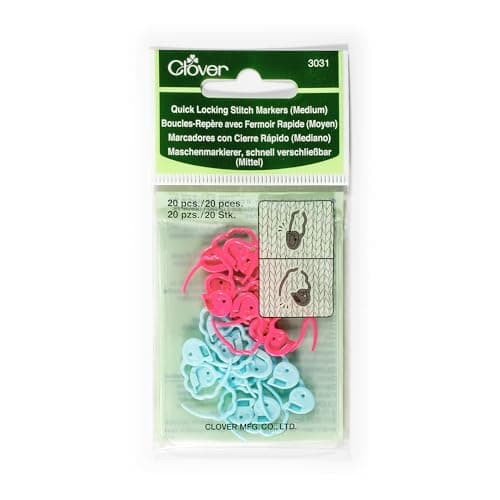
| 1 | Clover Quick Locking Stitch Markers, MediumTwenty locking markers in the medium size, shaped so they do not stretch the stitch. | Knitting and crochet, in one purchase | Locking, medium | 20 markers | $8.00 - View on Amazon#ad disclosure - price as of October 20, 2026 |
| 2 | 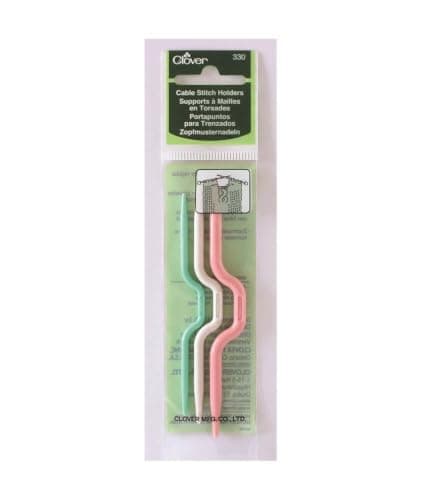 Clover Cable Stitch Holders (3-piece set)A different tool for a related job - holding several stitches out of the work. Clover Cable Stitch Holders (3-piece set)A different tool for a related job - holding several stitches out of the work. | Cables, and any stitch group held aside | Cable holder | 3 holders | Check price on Amazon#ad disclosure |
| 3 | 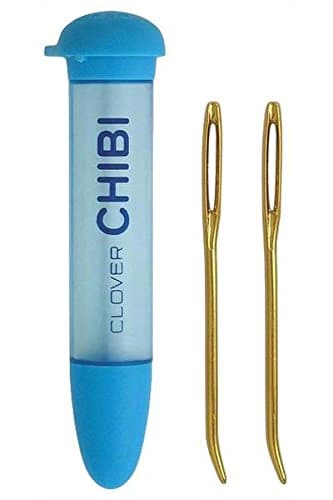 Clover Chibi Darning Needle Set (Bent Tip)The other notion no kit includes, and the one every finished project needs. Clover Chibi Darning Needle Set (Bent Tip)The other notion no kit includes, and the one every finished project needs. | Everything the markers were holding your place for | Tapestry needles | 3 needles | $9.14 - View on Amazon#ad disclosure - price as of October 20, 2026 |
| 4 | 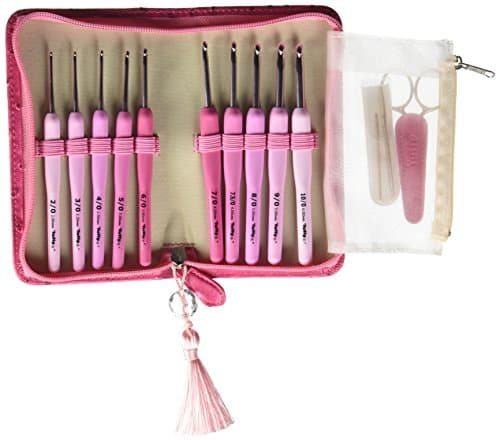 Tulip Etimo Rose Crochet Hook SetA very good hook set whose bundled extras are not why you would buy it. Tulip Etimo Rose Crochet Hook SetA very good hook set whose bundled extras are not why you would buy it. | The hooks, which are excellent | Hook set | 2 needles, scissors | $117.00 - View on Amazon#ad disclosure - price as of October 20, 2026 |
Clover Quick Locking Stitch Markers, Medium
Clover · Best for knitting and crochet, in one purchase
Markers that clip closed around a stitch instead of only sliding onto a needle - the medium size, which is the one that fits almost everything.
- Contents
- 20 markers, medium size
- Type
- Locking; also usable in the unlocked position
- Shape
- Undulated, so a marked stitch is not stretched
- Material
- Polyacetal
- Art. no.
- 3031; small is 3030 and large is 3032
Who it suits
Everyone. If you own one pack of markers, this is the one that covers both crafts.
Why it is here
20 pieces in the medium size, in polyacetal with a polypropylene case. They lock closed around a stitch, which crochet requires, and work unlocked on a needle, which knitting mostly wants. The undulated shape is specified to avoid stretching the marked stitch.
What you give up
Plastic markers can crack if they are forced closed on a bulky yarn, and 36 is more than a single project needs. The large size is more useful for knitting than for crochet.
Specifications from Clover USA - Quick Locking Stitch Markers (Medium). We have not handled this item - see how we pick.
Clover Cable Stitch Holders (3-piece set)
Clover · Best for cables, and any stitch group held aside
Three sizes of bent resin cable needle in one pack, so the holder can be matched to the yarn rather than the other way round.
- Set
- 3 pieces: small, medium, large
- Material
- ABS resin and polyacetal
- Shape
- Standard bent profile
- Suits
- Regular-size yarns
Who it suits
Anyone knitting cables, where a marker is not what you need and a cable needle is.
Why it is here
Three bent cable needles in one pack - small, medium and large - in ABS resin and polyacetal, so the holder can be matched to the yarn rather than the other way round. A marker holds a place; a holder holds stitches.
What you give up
It does not mark anything. This is a companion purchase, not an alternative, and it is only relevant if you knit cables.
Specifications from Clover USA product page. We have not handled this item - see how we pick.
Clover Chibi Darning Needle Set (Bent Tip)
Clover · Best for everything the markers were holding your place for
Three blunt bent-tip tapestry needles in a lidded tube, which is the only reason a tapestry needle is ever findable twice.
- Contents
- Three needles plus a holding tube
- Tip
- Bent, blunt - hooks the yarn without splitting the stitch
- Best with
- DK weight yarns and thinner
- Use
- Weaving in ends, seaming, grafting
Who it suits
Anyone buying markers, because the same project will end with ends to weave in.
Why it is here
Three blunt bent-tip darning needles in a holding tube, suited to DK weight yarn and thinner. The bent tip hooks yarn without splitting the stitch, and the tube is the only reason a tapestry needle is ever findable twice.
What you give up
Sized for DK and thinner, so a bulky or chenille yarn needs a larger jumbo needle instead.
Specifications from Clover Chibi darning needle set (bent tip) - retail specification. We have not handled this item - see how we pick.
Tulip Etimo Rose Crochet Hook Set
Tulip · Best for the hooks, which are excellent
Ten cushion-grip hooks from 2.00mm to 6.00mm, made in Hiroshima, with the finest size steps of any set here.
- Sizes
- 10 hooks: 2.00, 2.20, 2.50, 3.00, 3.50, 4.00, 4.50, 5.00, 5.50, 6.00mm
- Grip
- Cushioned rubber grip
- Head
- Polished tip, Tulip's own hook profile
- Also included
- Two darning needles, scissors, zipped case
- Made in
- Hiroshima, Japan
Who it suits
Not people shopping for markers. Buy this for the hooks if you want them; do not buy it to get notions.
Why it is here
Ten cushion-grip hooks from 2.00 to 6.00mm made in Hiroshima, with two darning needles, scissors and a zipped case included.
What you give up
The bundled notions are two needles and a pair of scissors. A dedicated 36-marker set and a three-needle tube cost a fraction of the difference and cover far more.
Specifications from Tulip Etimo Rose set specification. We have not handled this item - see how we pick.
Two types, one of which does everything
A stitch marker marks a position: the start of a round, a decrease point, a pattern repeat, a spot you need to come back to. There are two mechanisms for doing that.
| Locking | Ring | |
|---|---|---|
| Attaches to | A stitch, or a needle | A needle only |
| Works in crochet | Yes | No |
| Works in knitting | Yes | Yes |
| Can be moved later | Yes, anywhere in the fabric | Only along the needle |
| Marks a row for measuring | Yes | No |
| Slides freely on the needle | Less smoothly | Very smoothly |
| Fails by | Cracking if forced on bulky yarn | Falling off the end of the needle |
Ring markers are marginally nicer to knit past. Locking markers do everything else. If you are buying one type, it is not close.
Crochet needs locking, without exception
Crochet has no needle to hang a ring on. The live loop is on the hook and everything else is finished fabric, so a marker has to clip into the fabric itself.
This matters most in amigurumi, which is worked as a continuous spiral with no join. Without a marker in the first stitch of the round, there is nothing to tell you where the round began, and a miscount changes the shape of the toy. Our amigurumi hooks page treats markers as required equipment rather than an accessory.
What knitters use them for
- Beginning of round. On circular knitting there is no visible seam, so a marker on the needle is the only way to know where the round starts.
- Raglan and shaping points. Four markers turn a top-down sweater from a counting exercise into a mechanical one.
- Pattern repeats. A marker every repeat catches a mistake within one repeat instead of at the end of the row.
- Row counting in the fabric. A locking marker clipped into a row is how you measure length from a specific point - something a ring marker cannot do.
- Right side. One marker clipped to the front of the work saves a surprising number of mistakes.
How many do you need?
More than you think, and then no more ever again.
- Amigurumi: two or three. One in use, two lost under the sofa.
- A sweater with raglan shaping: five to nine at once - one per shaping point plus the beginning of round.
- Lace with repeats: one per repeat, which can be fifteen or twenty on a large shawl.
- A colorwork yoke: eight or more, marking each pattern segment.
Twenty is not excessive. It is roughly one large project's worth plus the ones that disappear.
What to avoid
Three styles cause problems often enough to be worth naming.
- Beaded markers with a dangling charm. Attractive, and the dangle catches on the yarn every row.
- Split-ring markers with a sharp end. They split plies, particularly on loosely spun yarn.
- Markers that are too small for your needle. A tight ring drags on every pass and eventually distorts the stitch beside it. Match marker size to needle size.
What we would buy
- The one purchase: the Clover Quick Locking Stitch Marker Set - 20 markers in the medium size.
- If you knit cables: cable stitch holders, which hold stitches rather than mark positions.
- Buy at the same time: a bent-tip tapestry needle set, because the project the markers are for will end with ends.
- Do not buy a hook set for its notions: the Tulip Etimo Rose is a fine hook set and an expensive way to acquire two needles.
Questions people actually ask
What is the difference between locking and ring stitch markers?
Locking markers clip closed around a stitch or a needle; ring markers only slide onto a needle. Locking markers work in both knitting and crochet, ring markers only in knitting.
Do you need stitch markers for crochet?
Yes, and locking ones specifically. Crochet has no needle to hang a ring on, and amigurumi worked in a continuous spiral has no join to count from without a marker in the first stitch.
How many stitch markers do I need?
A 20-piece pack covers most projects. A raglan sweater uses five to nine at once, a repeating lace pattern can use the whole pack, and markers disappear at a steady rate - so buy a second pack if you knit lace.
Can you use scrap yarn as a stitch marker?
Yes. A short loop of contrasting yarn tied in a knot works in both crafts and never cracks. It is slower to reposition and easier to lose, which is what you are paying to avoid.
What size stitch markers should I buy?
Match the marker to your needle or hook. A marker that is tight on the needle drags on every pass and can distort the neighboring stitch, which is why sets come in several sizes.