Guide
How to Count Rows and Stitches
Everyone counts. Almost nobody is taught where to start, which is why the numbers disagree.
By Sawyer V. · Published September 24, 2026
Disclosure: we earn a commission when you buy through the links on this page, at no extra cost to you. It never decides what we recommend or how we rank it - read the full disclosure.
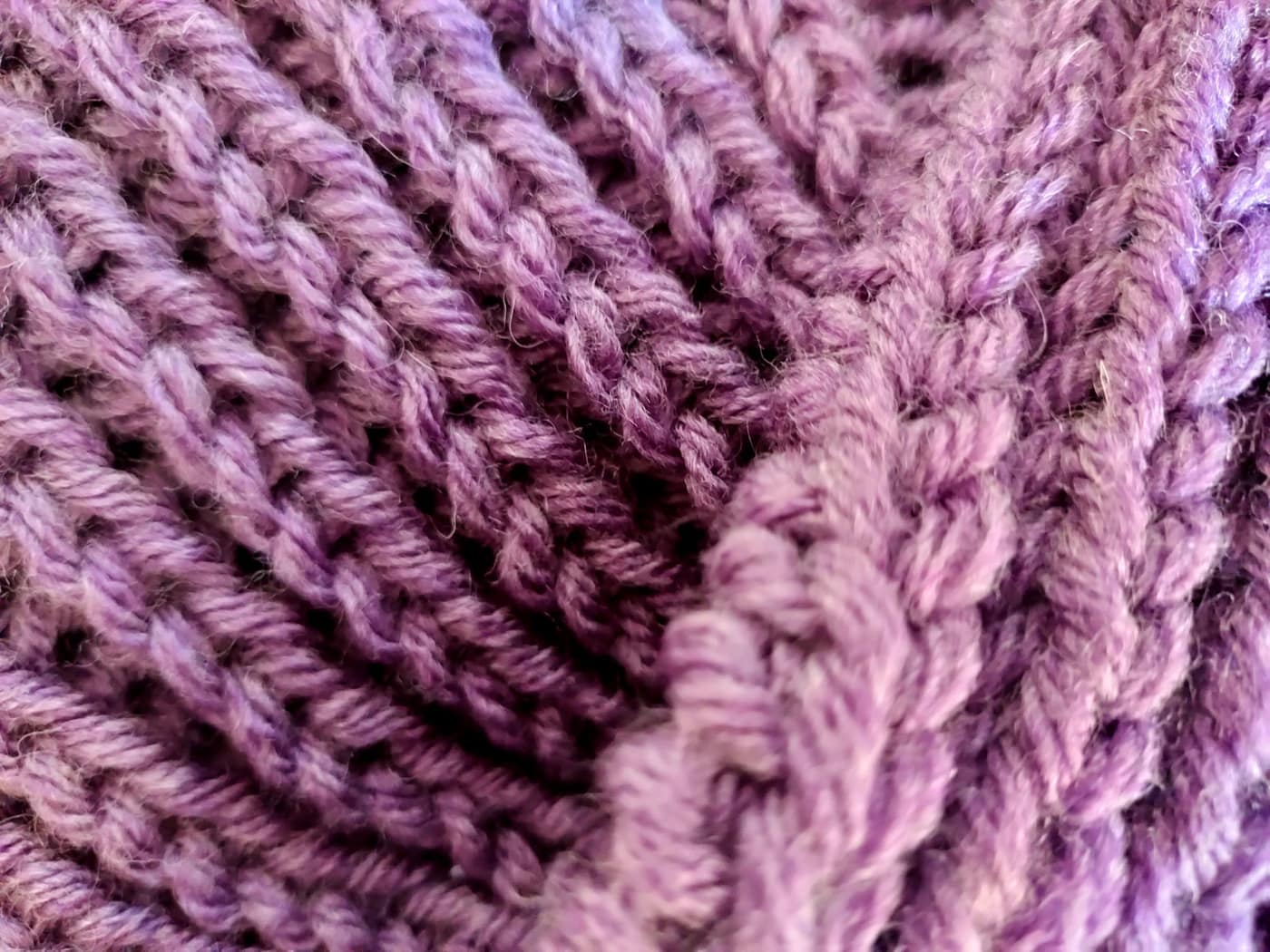
The short answer
In knitting, count the V shapes: each V is one stitch across, and each V stacked vertically is one row. Do not count the loop on the needle as a row. In crochet, count the tops of the stitches - the horizontal bars you work into - across, and the number of stitch bodies stacked up for rows, including the foundation chain only if the pattern says to. Then stop counting from the beginning: put a locking marker every ten stitches and every twentieth row, and count from the last marker instead.
Counting knitting
Stockinette fabric is made of interlocking V shapes on the right side. That is the unit.
- Stitches: count the Vs across a row. Each V is one stitch.
- Rows: count the Vs stacked vertically in one column. Each V is one row.
- Do not count the loops on the needle. Those are the live stitches of the row you are about to work, not a finished row.
- Do not count the cast-on edge as a row unless the pattern explicitly says it does.
- Count in good light, from the right side, with the fabric flat and unstretched.
Garter stitch is different and easier to get wrong: it forms ridges, and each visible ridge is two rows. Count the ridges and double. Ribbing is counted by column - each knit column and each purl column is one stitch.
Counting crochet
| Stitch | Counting across | Counting rows |
|---|---|---|
| Chain | Each V, not the loop on the hook | n/a |
| Single crochet | Each top - the pair of loops you work into | Each short stitch body |
| Double crochet | Each top | Each tall stitch body |
| Granny clusters | Each cluster, and each gap | Each round |
- Never count the loop on the hook as a chain or a stitch.
- The turning chain may or may not be a stitch. This decides whether your count agrees with the pattern's - see how to read a crochet pattern.
- Count the tops, not the posts. The tops are what the next row is worked into, so they are what the pattern's number refers to.
- The foundation chain is not a row in most patterns, but a minority count it. The pattern will say.
Stop counting from the beginning
Recounting 180 stitches every row is how counting becomes the reason people stop. The fix is to make each count short.
- Place a locking marker every ten stitches on the first row of a wide piece.
- Count the markers, then the stitches after the last one. Eighteen markers and four stitches is 184.
- Move the markers up every few rows, or leave them and let the fabric carry them.
- Mark every twentieth row with a marker on the edge. Then a row count is markers times twenty, plus the few since the last one.
- Never trust memory over a marker. The marker was placed when you were paying attention.
Counting rows a different way
- A mechanical counter clicks once per row and cannot be knocked out of sync by a phone notification. Reset it by turning the gears in the direction of the arrows.
- A tally on paper is the cheapest reliable method and works for anything.
- A row counter app works until a call interrupts it.
- Counting the fabric is the method of last resort but it is the only one that is verifiable, which is why the fabric-reading skills above still matter.
- Whichever you use, click or mark at the same point in each row - the end, not the start.
Counting for gauge
Gauge is a count over a measured distance, and it is the one count where the technique differs. Lay the swatch flat without stretching it, measure a 4 inch span in the middle of the fabric rather than at the edges, and count the stitches and rows inside it.
- Measure in the middle. Edge stitches are always a different size.
- Include partial stitches as halves rather than rounding - gauge is sensitive.
- Block the swatch first if you will block the finished piece.
- Measure over 4 inches, not 1. Small errors multiply.
Knitting gauge and swatching covers the full method, and how much yarn do I need uses the result.
When the count is wrong
A count that does not match the pattern means one of three things: you have gained a stitch, lost one, or you are counting differently from the designer - most often over the turning chain in crochet or the cast-on edge in knitting.
Check the convention first, because it is free. Then look for the error. How to fix crochet mistakes and how to fix common knitting mistakes cover the repairs.
What makes counting easier
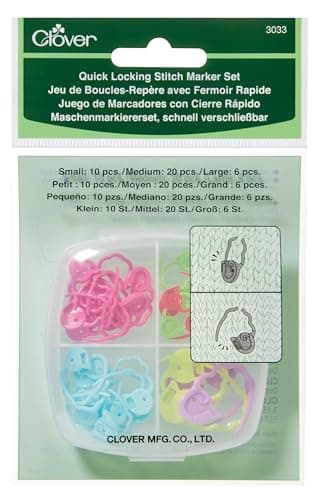
Clover Quick Locking Stitch Marker Set
36 markers in three sizes that lock closed around a stitch, in an undulated shape so the marked stitch is not stretched.
$12.72 - View on Amazon#ad disclosure - price as of September 24, 2026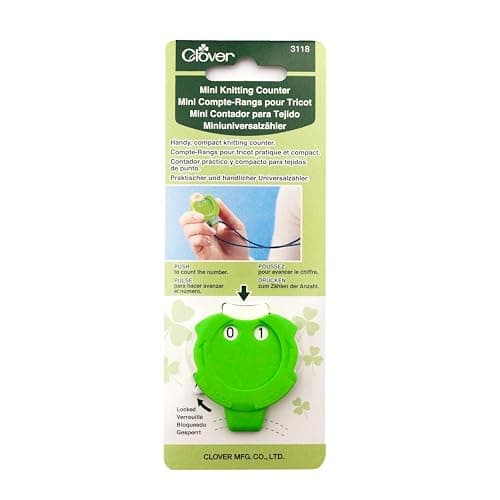
Clover Knitting Counter (Kacha-Kacha)
A mechanical push-top counter, 0 to 99, with no battery and nothing to knock out of sync. Each push advances the count by one.
$9.90 - View on Amazon#ad disclosure - price as of September 24, 2026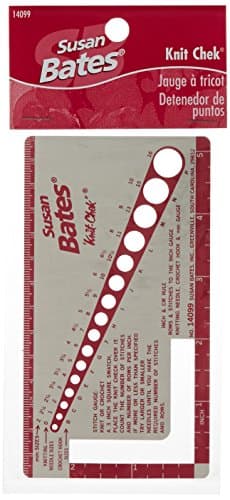
Susan Bates Knit-Chek Needle Gauge
Measures stitch and row gauge as well as checking needle sizes from US 0 / B-1 to P-16 (2.0 to 11.5mm), 5.5 x 3in.
$7.99 - View on Amazon$9.9820% off · #ad disclosure - price as of September 24, 2026
Questions people actually ask
How do you count rows in knitting?
Count the V shapes stacked vertically in a single column on the right side of stockinette - each V is one row. Do not count the loops on the needle, and do not count the cast-on edge unless the pattern says to.
How do you count rows in garter stitch?
Count the visible ridges and multiply by two, because each ridge is made of two rows. Counting ridges as rows is the commonest reason a garter piece comes out half the intended length.
Do you count the loop on the hook as a stitch?
No, in either chains or stitches. The loop on the hook is the live loop you are about to work with, not a completed stitch. Counting it is the classic source of a chain that is one too long.
Does the foundation chain count as a row?
In most crochet patterns it does not, though a minority count it. The pattern will tell you, and it matters because it shifts every subsequent row number by one.
What is the easiest way to keep count on a big project?
Place a locking marker every ten stitches and every twentieth row. Then counting means counting markers and adding the few since the last one, instead of starting from the beginning each time.