Guide
How to Fix Crochet Mistakes
Crochet cannot be laddered back one stitch at a time. That sounds worse than it is, and it changes the whole repair strategy.
By Sawyer V. · Published September 24, 2026
Disclosure: we earn a commission when you buy through the links on this page, at no extra cost to you. It never decides what we recommend or how we rank it - read the full disclosure.
The short answer
Find where the error started by counting back, put a locking marker in the last correct row, and undo to it. Crochet cannot be unpicked one stitch at a time from below the way knitting can, so undoing back to the mistake is usually the only clean fix - and it is faster than it sounds, because crochet pulls out in one continuous strand. Repair in place only when the piece is finished, or when the error is cosmetic and isolated.
Why crochet repairs differ from knitting repairs
In knitting, every stitch sits live on a needle, which is why a dropped stitch can be laddered back up with a hook and the rest of the fabric left alone. Crochet has exactly one live loop at any moment, and each stitch is locked by the one worked into it.
- You cannot pick up a crochet stitch from ten rows down and rebuild just that column.
- But crochet also does not run. Drop the live loop and the fabric simply stops; it does not unravel downwards on its own.
- Undoing is fast. Pull the working yarn and the stitches come out in one continuous strand, far quicker than knitting comes off the needles.
- So the calculus flips. In knitting you repair to avoid ripping; in crochet you rip because it is cheap.
The five commonest errors
| Error | Symptom | Usual cause |
|---|---|---|
| Wrong stitch count | Piece widens or narrows | Turning chain counted inconsistently |
| Missed last stitch | Piece narrows one stitch per row | Not working into the turning chain |
| Extra stitch at the start | Piece widens one stitch per row | Working into the turning chain when it does not count |
| Wrong stitch worked | A visible dip or bump in one place | Losing your place in a repeat |
| Split stitch | A loose strand across a stitch | Hook entering between plies |
Three of those five are the turning chain. If your piece is steadily getting wider or narrower, that is where to look first - how to read a crochet pattern explains the convention.
Finding where it started
- Count the current row. Compare it against the pattern's stated stitch count.
- Count the row below, and the one below that. Work back until you reach a row with the correct count.
- Mark that row with a locking marker. That is your target.
- Look along the marked row for the physical error if the count is right but the fabric looks wrong.
- If a piece is widening or narrowing steadily, the error is repeating - it is a habit, not an event, and it started at the first row with the wrong count.
Undoing, safely
- Take the hook out and pull the working yarn. Crochet comes out in one strand.
- Undo one row past the error rather than stopping exactly at it - the last row before a mistake is often half wrong.
- Stop at the marker, then put the hook back into the live loop.
- Wind the yarn back onto the ball as you go rather than letting it pile up.
- Give crinkled yarn a rest before reusing it, or block the finished piece to settle it. Acrylic holds a crinkle longer than wool.
- Count the row you have arrived at before starting again.
Repairing without undoing
Sometimes undoing is not reasonable - the piece is finished, the error is forty rows down, or the project is a gift due tomorrow. There are three real options.
- Duplicate the stitch by hand. With a tapestry needle and a length of the same yarn, follow the path a correct stitch would take over the wrong one. Works for a single wrong stitch in plain fabric.
- Tighten a split stitch. Coax the loose strand back into line with a blunt needle. Works if it is caught early.
- Cut and reconstruct. Snip one stitch, unpick the row sideways to the error, rework it and secure the ends. This is the advanced option and it deserves a practice swatch first.
- Or leave it. Blocking hides a great deal, and a single stitch in a blanket is invisible to everyone but you.
How to repair a hand-knit covers the equivalent surgery on knitted fabric.
Not making them in the first place
- Count every row against the pattern's stated number. This is the whole game.
- Mark every tenth stitch on a wide piece, so an error can never travel far unnoticed.
- Mark the first stitch of every round when working in a spiral, and move the marker as you pass it.
- Decide about the turning chain once, at the start, and never revisit it mid-piece.
- Stop when you are tired. Most crochet errors are made in the last ten minutes of a session.
How to count rows and stitches covers the counting itself.
What a repair needs on the table
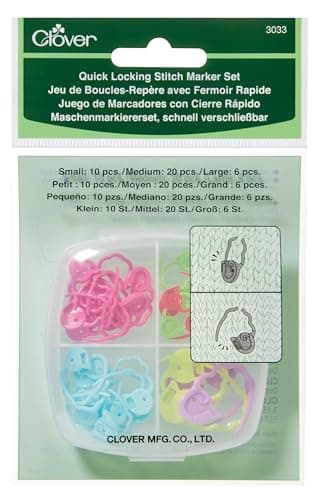
Clover Quick Locking Stitch Marker Set
36 markers in three sizes that clip closed around a stitch. Mark every tenth stitch and an error can never travel more than ten stitches before you find it.
$12.72 - View on Amazon#ad disclosure - price as of September 24, 2026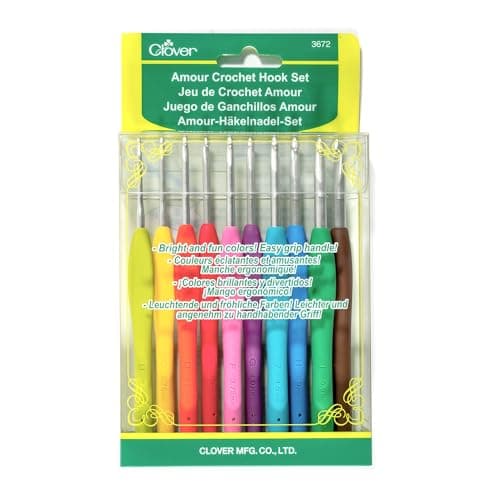
Clover Amour Crochet Hook Set
Ten hooks, B/2.25mm to J/6.0mm. A hook one size smaller than the project's makes picking up a dropped loop far easier.
$45.67 - View on Amazon$49.037% off · #ad disclosure - price as of September 24, 2026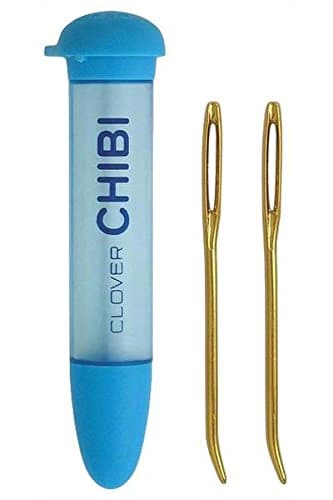
Clover Chibi Darning Needle Set (Bent Tip)
Blunt bent-tip tapestry needles - what you use to duplicate a stitch by hand when undoing is not an option.
$8.80 - View on Amazon#ad disclosure - price as of September 24, 2026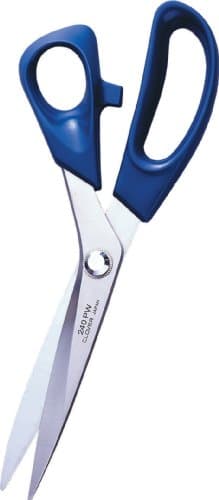
Clover Patchwork Scissors
Serrated blades cut a yarn end square rather than skidding off it, which matters when you are cutting into finished fabric.
$69.10 - View on Amazon#ad disclosure - price as of September 24, 2026
Questions people actually ask
How do you fix a crochet mistake without undoing everything?
For a single wrong stitch in plain fabric, duplicate the correct stitch over it by hand with a tapestry needle. For a split stitch caught early, coax the loose strand back with a blunt needle. Anything more usually needs undoing back to the error.
Why does my crochet keep getting narrower?
You are almost certainly missing the last stitch of each row - usually the one worked into the turning chain. Count every row against the pattern's stated number and the problem shows up immediately.
Can you drop a stitch in crochet?
Not the way knitting does. Crochet has one live loop, and if you drop it the fabric stops rather than unravelling downwards. That makes crochet more forgiving to put down and less forgiving to repair in place.
How far back should I undo a crochet mistake?
One row past the error. The last row before a mistake is often already half wrong, and undoing crochet is fast - the stitches come out in a single continuous strand.
Can I reuse yarn that has been undone?
Yes. It will be crinkled, which relaxes with a rest or disappears with blocking. Acrylic holds the crinkle longest; wool recovers fastest.