Reference
How to Read a Crochet Pattern
The abbreviations are the easy part. The punctuation is what stops people.
By Sawyer V. · Published September 24, 2026
Disclosure: we earn a commission when you buy through the links on this page, at no extra cost to you. It never decides what we recommend or how we rank it - read the full disclosure.
The short answer
Read the header first - gauge, hook, yarn, finished size and special stitches - then work the instructions line by line. An asterisk marks the start of a repeat and "rep from *" sends you back to it. Parentheses and brackets group stitches worked into one place or repeated a stated number of times. The number in parentheses at the end of a row is the stitch count you should have. Check it every row; that number is how you catch a mistake before it costs you an hour.
Read the header before the first stitch
Everything above the first row of instructions is there to be read, and skipping it is the commonest reason a finished piece comes out the wrong size.
- Finished measurements, and which size's numbers you are following.
- Gauge, stated as a number of stitches and rows over a stated distance in a stated stitch. Match this or the size is not the stated size.
- Hook size, which is the pattern's starting suggestion, not an instruction - you use whatever hook gets you the gauge.
- Yarn, with a weight category and a yardage. The brand named is rarely essential; the weight and yardage are.
- Special stitches, written out in full. Read these now rather than at the row that first uses one.
- Notes, which is where the designer says whether the turning chain counts as a stitch. That one line changes the whole pattern.
The punctuation, one symbol at a time
| Symbol | Means | Example |
|---|---|---|
| * | Start of a repeat | *sc in next 2 sts, 2 sc in next st |
| rep from * | Go back to the asterisk and work it again | rep from * to end |
| ( ) | Stitches worked into one stitch or space | (2 dc, ch 2, 2 dc) in next sp |
| ( ) x times | A group repeated a stated number of times | (sc, ch 1) 6 times |
| [ ] | A larger group, often holding parentheses | [sc, (dc, ch 1) twice] 3 times |
| ( ) at row end | The stitch count you should have | (24 sts) |
| Sizes in ( ) | Size options in order, smallest first | ch 60 (66, 72, 78) |
Parentheses doing two unrelated jobs in one pattern is not a mistake; it is the convention. Position tells you which is which - mid-row means a group of stitches, end of row means a count, top of the pattern means sizing.
The number at the end of the row
If a crochet pattern gives you one habit, make it this one. The figure in parentheses at the end of each row or round is the number of stitches you should be holding when that row is finished.
- Count every single row until the piece is established, then every few rows once it is.
- One stitch out is almost always the turning chain - either counted when it should not be, or the reverse.
- Two or more out is usually a missed last stitch, which is the easiest stitch in crochet to lose.
- Fix it now. Undoing two rows is a few minutes; discovering it fifteen rows later is an evening.
- No count given? Write your own in the margin on the first row. Many older patterns omit them.
How to count rows and stitches covers the counting itself, and how to fix crochet mistakes covers what to do when the number is wrong.
Turning chains, and why they are confusing
At the end of a row you chain a number of stitches to bring the hook up to the height of the next row. The chain is taller for taller stitches, and whether it counts as a stitch is the designer's choice.
| Stitch | Turning chain | Usually counts as a stitch? |
|---|---|---|
| Single crochet | ch 1 | No |
| Half double crochet | ch 2 | Sometimes |
| Double crochet | ch 3 | Usually yes |
| Treble crochet | ch 4 | Usually yes |
Read the notes, decide once, and stay consistent for the whole piece. Switching halfway produces an edge that visibly waves, and it is the reason most stitch counts drift.
Rows, rounds and joins
- Rows are worked flat, turning at the end of each one so the fabric alternates faces.
- Joined rounds finish with a slip stitch into the first stitch, which produces a visible seam line up the piece.
- Spiral rounds never join - you simply keep going, which is why amigurumi patterns use them.
- Mark the first stitch of every round. In a spiral there is nothing else to tell you where a round begins.
- Move the marker as you pass it, each round, without fail.
Charts instead of words
Some patterns give a symbol chart rather than written rows, and some give both. A chart is a picture of the finished fabric with one symbol per stitch, read from the bottom up, and alternating direction on flat rows.
Charts are far easier for lace and motifs, where written instructions become unreadable. Crochet symbol charts explained covers the symbols themselves.
A working order
- Read the whole pattern through before buying yarn. Unfamiliar techniques are cheaper to discover now.
- Highlight your size everywhere it appears, if the pattern has sizes.
- Swatch and check gauge, changing hook size until it matches.
- Read the special stitches and try each one on the swatch.
- Work the first row and count it against the stated number.
- Keep counting at the end of every row.
What reading a pattern needs on the table
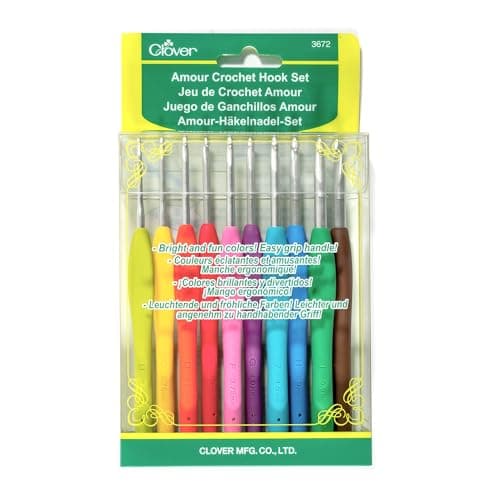
Clover Amour Crochet Hook Set
Ten hooks from B/2.25mm to J/6.0mm, so whatever size the pattern names is in the case.
$45.67 - View on Amazon$49.037% off · #ad disclosure - price as of September 24, 2026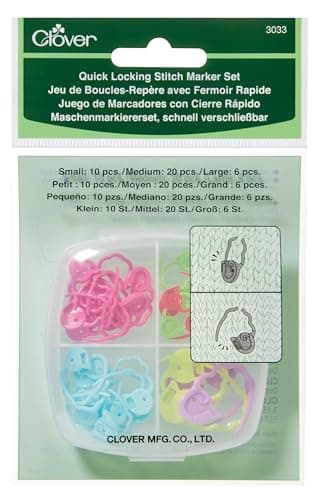
Clover Quick Locking Stitch Marker Set
Locking markers for the first stitch of a round - the single thing that prevents the commonest counting error in crochet.
$12.72 - View on Amazon#ad disclosure - price as of September 24, 2026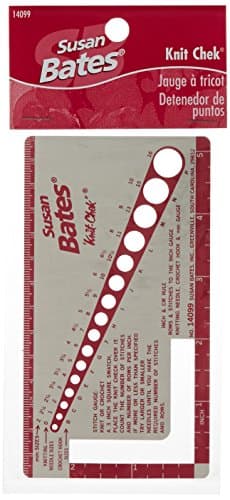
Susan Bates Knit-Chek Needle Gauge
Checks a hook against the pattern's size and measures gauge, B-1 to P-16 (2.0 to 11.5mm), 5.5 x 3in.
$7.99 - View on Amazon$9.9820% off · #ad disclosure - price as of September 24, 2026
Questions people actually ask
What does the asterisk mean in a crochet pattern?
It marks the start of a repeat. When you reach the instruction to repeat from the asterisk, you go back to it and work the same sequence again, usually to the end of the row or for a stated number of repeats.
What do parentheses mean in crochet?
Three different things, told apart by position. Mid-row they group stitches worked into one place or repeated a set number of times; at the end of a row they give the stitch count; at the top of the pattern they list the sizes.
Does the turning chain count as a stitch?
It depends on the pattern, which is why designers state it in the notes. A chain 1 before single crochet usually does not; a chain 3 before double crochet usually does. Decide once and stay consistent, or your edges will wave.
What does the number at the end of a crochet row mean?
It is the number of stitches you should have on that row. Check it every row - one stitch out is nearly always the turning chain, and catching it immediately saves undoing a lot of work later.
How do I know if a pattern uses US or UK terms?
Most patterns say so in the notes. If yours does not, look for sc - single crochet exists in US terminology and not in UK. A US single crochet is a UK double crochet, so reading the wrong set produces a completely different fabric.