Reference
How to Read a Knitting Pattern
Read it all the way through before casting on. Almost every pattern disaster is something that was written on page one.
By Sawyer V. · Published September 12, 2026
Disclosure: we earn a commission when you buy through the links on this page, at no extra cost to you. It never decides what we recommend or how we rank it - read the full disclosure.

The short answer
Read the whole pattern before you cast on. Check the gauge, the finished measurements and the yardage first - those three decide whether the project will work at all. Then learn its notation: brackets and asterisks mark repeats, numbers in parentheses give the other sizes, and a schematic gives the real dimensions the words only describe.
The sections, and what each is for
| Section | What it tells you | Read it when? |
|---|---|---|
| Sizes | Which sizes the pattern is written for | First |
| Finished measurements | The actual dimensions of each size | First |
| Materials | Yarn, yardage, needles, notions | First |
| Gauge | Stitches and rows over 4in, in pattern | First - this decides everything |
| Notes | Construction, and anything unusual | Before casting on |
| Abbreviations | This pattern's shorthand | As needed |
| Special stitches | Anything non-standard | Before you reach them |
| Instructions | The actual knitting | In order |
| Finishing | Seaming, bands, blocking | Before you start, not after |
| Schematic | A dimensioned drawing | First, honestly |
Sizes and parentheses
A multi-size pattern is written for the smallest size first, with the others in parentheses afterwards - for example: Cast on 84 (92, 100, 108, 116) sts.
- Work out your size from the finished measurements, not from a dress size.
- Highlight your numbers throughout the whole pattern before you start. Every single one.
- A dash means nothing is worked for that size at that instruction.
- Numbers stay in the same order everywhere in the pattern - the third number is always the third size.
- Ease matters. A pattern's finished chest measurement includes the ease the designer intended; compare it against a garment you already own and like.
Repeats: brackets, asterisks and parentheses
| Notation | Means | Example |
|---|---|---|
| *...; rep from * to end | Repeat everything after the asterisk | *K2, p2; rep from * to end |
| [...] x 4 | Work what is inside four times | [K2tog, yo] x 4 |
| (...) twice | Same as brackets; older style | (K1, p1) twice |
| *...; rep from * to last 4 sts | Repeat, then follow the tail instruction | *K3, p1; rep from * to last 4 sts, k4 |
Parentheses do double duty - they hold sizes and they hold repeats - which is a genuine source of confusion. Context decides: a parenthesis full of numbers separated by commas is sizes; one containing instructions is a repeat.
The stitch count in parentheses at the end of a row
Many rows end with a figure like (84 sts). That is not part of the instruction - it is the number of stitches you should have when the row is finished.
Count against it every time it appears. It is the pattern's built-in error check and it is the difference between finding a mistake one row later and finding it twenty rows later. How to fix common knitting mistakes covers what to do when the count is wrong.
Gauge is the section that decides the project
- It is given over 4in, not over one inch, because small measurements magnify error.
- It says in what stitch. Gauge in stocking stitch and gauge in the pattern stitch are different numbers.
- It says blocked or unblocked. If it does not say, assume blocked.
- Match stitches first, rows second. Row gauge can usually be worked around by knitting to a measurement.
- Change needle size to match, not your knitting. Trying to knit tighter or looser deliberately never holds.
If the pattern's gauge and yours will not meet, the garment will not be the size on the schematic. Knitting gauge and swatching is the method.
The schematic
A dimensioned line drawing of the finished pieces. It is usually at the end and it is the most useful single page in the pattern.
- It gives real numbers for body length, sleeve length, upper arm and chest.
- It shows the construction at a glance - set-in sleeve, raglan, drop shoulder.
- It lets you compare against a garment you own by laying the garment flat and measuring it.
- It tells you what to change. Lengthening a body is easy when you know the target length.
Compare it against standard garment measurements if you are between sizes.
Charts
- Read right to left on right-side rows, left to right on wrong-side rows, working bottom to top.
- In the round, every row reads right to left.
- The key is not universal. Read this pattern's key rather than assuming.
- Bold outlines mark the repeat. Work the stitches before it once, the outlined section as many times as fits, then the stitches after it.
- A gray or blank square usually means 'no stitch' - a spacer that keeps the chart rectangular when one size needs fewer stitches than another.
The crochet equivalent is in crochet symbol charts explained, and abbreviations are in knitting abbreviations explained.
Before you cast on
- Read it through, all of it, including finishing.
- Highlight your size everywhere it appears.
- Check the total yardage against what you have bought.
- Swatch, wash the swatch, and measure it.
- Note any technique you do not know yet and learn it before you need it, not in the middle of a row.
- Check the errata. Published patterns get corrections; the designer's page usually lists them.
What reading a pattern properly needs
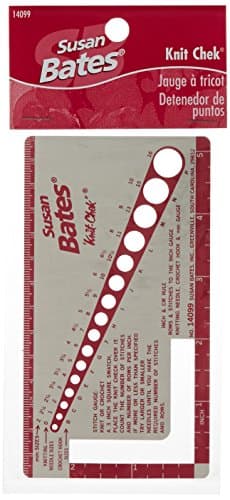
Susan Bates Knit-Chek Needle Gauge
Measures US 0 / B-1 to P-16 and does stitch and row gauge - for checking your swatch against the pattern's number.
$7.99 - View on Amazon$9.9820% off · #ad disclosure - price as of September 21, 2026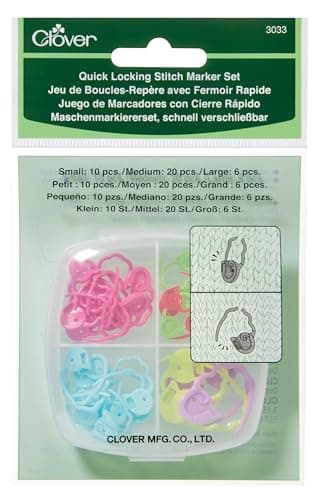
Clover Quick Locking Stitch Marker Set
36 locking markers in three sizes, undulated so a marked stitch is not stretched. Mark every repeat boundary.
$12.33 - View on Amazon#ad disclosure - price as of September 21, 2026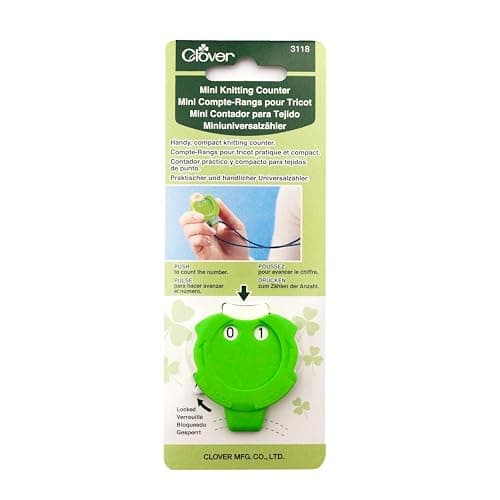
Clover Knitting Counter (Kacha-Kacha)
Counts 0 to 99, one push per row, reset by turning the gears. Fully mechanical - nothing to charge or lose.
$9.87 - View on Amazon#ad disclosure - price as of September 21, 2026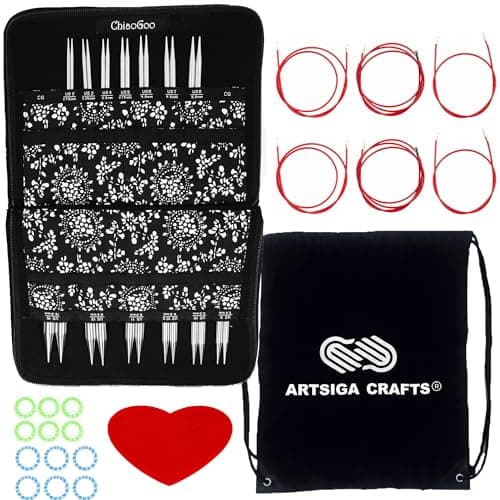
ChiaoGoo TWIST Red Lace Interchangeable Set (Complete, 5in tips)
The lifeline hole in every tip turns a misread repeat into an hour's work rather than a ruined project.
$216.80 - View on Amazon#ad disclosure - price as of September 21, 2026
Questions people actually ask
What do the numbers in parentheses mean in a knitting pattern?
Usually the other sizes - the smallest size is given first and the rest follow in parentheses in the same order throughout. A figure in parentheses at the end of a row is different: that is the stitch count you should have.
What does an asterisk mean in a knitting pattern?
It marks the start of a repeat. '*K2, p2; rep from * to end' means work knit two, purl two over and over until the row ends. Square brackets with a multiplier do the same job for a shorter repeat.
How do I know which size to knit?
From the finished measurements and the schematic, not from a clothing size. Measure a garment you already own and like, lay it flat, and choose the size whose finished chest measurement is closest.
Do I have to swatch if the pattern says to?
For anything that has to fit, yes. Gauge is what converts stitch counts into inches, so if your gauge differs from the pattern's the finished garment will not be the size on the schematic. Change needle size to match rather than trying to knit differently.
Which direction do you read a knitting chart?
Bottom to top, right to left on right-side rows and left to right on wrong-side rows. Worked in the round, every row reads right to left. Read the pattern's own key rather than assuming the symbols are standard.