Reference
Crochet Symbol Charts Explained
A chart draws the stitch instead of naming it, which is why it sidesteps the US and UK problem entirely.
By Sawyer V. · Published September 7, 2026
Disclosure: we earn a commission when you buy through the links on this page, at no extra cost to you. It never decides what we recommend or how we rank it - read the full disclosure.
The short answer
A crochet symbol chart draws a picture of each stitch at roughly its real height and position, so you read the fabric rather than a sentence. It is language-independent, which means a chart written anywhere works without knowing whether the designer used US or UK stitch names.
Why charts exist
Written crochet patterns have two problems that charts do not.
- Terminology. The same words name different stitches in US and UK usage - a genuine hazard covered on crochet abbreviations US vs UK. A chart draws the stitch, so there is nothing to mistranslate.
- Spatial relationships. A written pattern says work 3 dc in the next ch-2 space. A chart shows you which space, which is far easier to follow in a complex motif.
That second reason is why doilies, granny squares and lace motifs are almost always charted. A written version of a complex round is a paragraph; the chart is a picture you can compare against your work.
The common symbols
| Symbol | Stitch (US) | Stitch (UK) | Note |
|---|---|---|---|
| Oval or small dash | Chain | Chain | The foundation and the turning chain |
| Dot or small filled oval | Slip stitch | Slip stitch | Joins a round; travels without height |
| Cross or plus sign | Single crochet | Double crochet | The shortest working stitch |
| T with one bar | Half double crochet | Half treble | |
| T with a single crossbar | Double crochet | Treble | The most common stitch in charts |
| T with two crossbars | Treble | Double treble | Taller again |
| Several symbols joined at the base | A cluster or shell | Same | All worked into one stitch or space |
| Several symbols joined at the top | A decrease | Same | Worked together into one |
| Open circle in the center | Magic ring or chain ring | Same | How a round motif starts |
The system is broadly consistent internationally, and the height of each symbol on the page approximates the height of the stitch in the fabric. That is the whole idea: the chart is a diagram of the finished piece.
Reading a chart worked flat
- Find row 1. It is usually at the bottom, above the foundation chain.
- Check the row number position. A number on the right means read that row right to left; a number on the left means left to right.
- Rows alternate direction. You turn at the end of each row, so the reading direction alternates - exactly as the work does.
- Follow the turning chain. It is drawn at the start of each row, and the chart shows whether it counts as a stitch by whether a stitch symbol sits on top of it.
- Read the repeat brackets. A bracketed section with a multiplier works the same as in a written pattern.
Reading a chart worked in the round
Round charts are drawn as concentric rings, starting from a ring or magic circle at the center and growing outward.
- Read counterclockwise for right-handed crochet, which is the direction the work grows.
- Each round is a ring of symbols. The round number sits at the start of that ring.
- A slip stitch symbol closes each round, if the pattern joins rather than spiralling.
- A spiral pattern has no join symbol - which is exactly the case where a stitch marker is required rather than helpful.
- Increases show as two symbols sharing a base, which is why a round motif visibly widens on the page.
What charts do not tell you
Charts are not a complete replacement for written instructions, and a good pattern includes both.
- Yarn and hook. Always in the written material, never in the chart.
- Gauge. Same - and it still matters, see gauge and swatching.
- Color changes. Usually shown by symbol color, which fails on a photocopy or a grayscale print.
- Finishing and assembly. Charts show one piece; seaming and edging are written.
- Which loop to work into. Back-loop-only and front-loop-only are shown by a small added mark that is easy to miss at small print sizes.
Learning to read one
The fastest route is to take a pattern you already know in written form and read its chart alongside. Working from both at once, the mapping becomes obvious within a round or two, because you can see which symbol corresponds to the stitch you just made.
A granny square is the ideal first chart: three rounds, a small symbol vocabulary, and the chart looks unmistakably like the finished square - see best yarn for granny squares.
Knitting charts are a different system
Worth flagging so the two do not get confused. Knitting charts use a grid where one square is one stitch, with a symbol inside for what to do - they are not scaled to stitch height the way crochet charts are.
They also read from the bottom right for right-side rows and reverse for wrong-side rows. The vocabulary is on our knitting abbreviations page.
What makes chart work easier
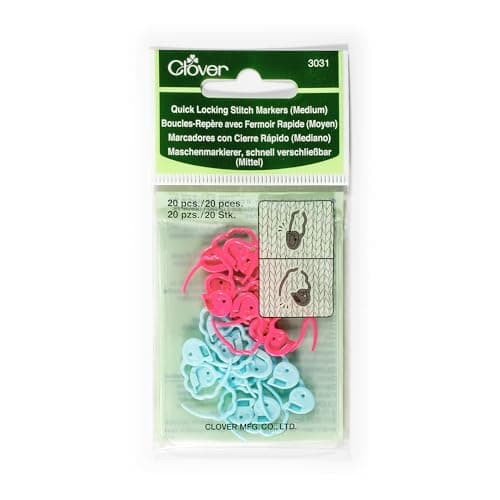
Clover Quick Locking Stitch Markers, Medium
A marker at each pattern repeat catches a misread symbol within one repeat instead of at the end of the round.
$8.00 - View on Amazon#ad disclosure - price as of October 22, 2026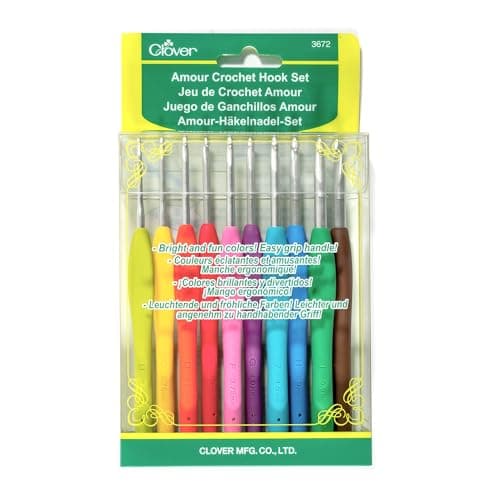
Clover Amour Crochet Hook Set
Charts are size-agnostic; owning the whole 2.25-6.0mm range means the chart's hook size is never the obstacle.
$49.67 - View on Amazon#ad disclosure - price as of October 22, 2026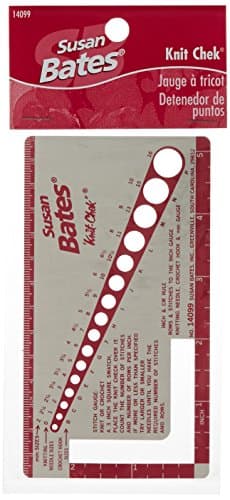
Susan Bates Knit-Chek Needle Gauge
Charts specify gauge, and a gauge window is how you check you are hitting it.
$9.40 - View on Amazon#ad disclosure - price as of October 22, 2026
Questions people actually ask
How do you read a crochet chart?
Start at row 1 above the foundation chain and follow the row number - a number on the right means read right to left. Rows alternate direction because you turn at the end of each one. Round charts read outward from the center, counterclockwise.
Do crochet symbol charts avoid the US/UK terms problem?
Yes. A chart draws each stitch at its own height rather than naming it, so there is nothing to mistranslate - a chart written anywhere works without knowing which terminology the designer used.
What does a cross symbol mean in a crochet chart?
A cross or plus sign is single crochet in US terms, which is double crochet in UK terms. It is the shortest working stitch, which is why the symbol has no vertical stem.
How do left-handed crocheters read a chart?
Mirrored - start each row at the opposite end from the one the chart indicates, because you work in the opposite direction. Nothing else changes.
Are knitting charts read the same way as crochet charts?
No. Knitting charts are a grid where one square is one stitch, read from the bottom right for right-side rows. Crochet charts draw each stitch at its real height and shape.