Reference
Gauge and Swatching
The twenty minutes that decides whether the sweater fits. Here is the arithmetic.
By Sawyer V. · Published September 4, 2026
Disclosure: we earn a commission when you buy through the links on this page, at no extra cost to you. It never decides what we recommend or how we rank it - read the full disclosure.
The short answer
Gauge is the number of stitches and rows in four inches of fabric. Knit a swatch at least six inches square in the pattern stitch, wash and dry it exactly as you will treat the finished piece, then measure in the middle. If you have more stitches than the pattern, go up a needle size. If you have fewer, go down.
Why four inches, and why the middle
Gauge is quoted per four inches (10cm) rather than per inch because measuring one inch and multiplying multiplies the error with it. A half-stitch mistake over one inch becomes two stitches over a sweater front.
You measure in the middle of the swatch because edge stitches are always distorted. The first and last stitch of every row is looser, and the cast-on and bind-off pull the ends in.
The Craft Yarn Council's own instruction is to cast on four times the pattern's stitches-per-inch and work a four-inch square. We would make it larger than that - six inches square - for exactly the edge reason above: a four-inch swatch gives you four inches of fabric with no clean four inches inside it.
How to make a swatch that tells the truth
- Use the yarn you will use. Not a similar one, not a leftover in a different color. Dye lots and colorways can differ in thickness.
- Use the stitch pattern you will use. Stockinette gauge and cable gauge are not the same number, and neither is ribbing.
- Cast on enough. Take the pattern's stitch count for four inches, multiply by 1.5, and add four for edges.
- Knit at your normal speed, relaxed. A carefully-knitted swatch followed by a comfortable garment is a useless comparison.
- Bind off loosely, or leave it live. A tight bind-off distorts the top of the swatch.
- Wash and dry it as you will treat the garment. This is the step everyone skips and it is the one that matters most.
Blocking changes the number, sometimes a lot
Fabric off the needles is not the fabric you will wear. Washing lets the yarn relax, bloom and settle, and the gauge afterwards is the gauge that matters.
| Fiber | What blocking does | Practical effect |
|---|---|---|
| Untreated wool | Relaxes and evens; stitches bloom | Modest change; the fabric looks much better |
| Superwash wool | Relaxes and grows, especially in length | Can grow noticeably - swatch and hang it |
| Cotton | Shrinks slightly once, then stable | Measure after washing, not before |
| Acrylic | Barely moves under a wet block | Steam changes it permanently; wet blocking does not |
| Alpaca and blends | Grows and keeps growing under weight | Hang the blocked swatch overnight before measuring |
For superwash and alpaca in particular, hang the wet swatch with a small weight overnight - that is what the garment will do on your shoulders. Our blocking superwash wool page covers the growth problem in detail.
Reading the result, and what to change
Compare your four-inch counts against the pattern's.
- More stitches in four inches than the pattern: your stitches are too small. Go up a needle size.
- Fewer stitches in four inches: your stitches are too big. Go down a needle size.
- Stitch gauge right, row gauge wrong: usually fine. Most patterns are worked to a measured length rather than a row count, so match stitches first.
- Neither can be made to match: the yarn is the wrong weight for the pattern. Check the yarn weight chart and substitute properly.
One needle size typically moves stitch gauge by roughly half a stitch per four inches in worsted weight. If you are two stitches out, expect to move three or four sizes, at which point the fabric will be too loose or too dense - and the honest answer is a different yarn.
The arithmetic of getting it wrong
This is the part that makes people swatch, so it is worth doing explicitly.
Take a sweater with a 40in finished chest, at a pattern gauge of 20 stitches per 4in - which is 5 stitches per inch, so 200 stitches around.
| Your gauge (per 4in) | Stitches per inch | 200 stitches becomes | Error |
|---|---|---|---|
| 20 - on gauge | 5.0 | 40in | None |
| 21 - half a stitch tight | 5.25 | 38.1in | Nearly 2in too small |
| 22 - one stitch tight | 5.5 | 36.4in | Over 3.5in too small - a full size |
| 19 - one stitch loose | 4.75 | 42.1in | Over 2in too big |
| 18 - two stitches loose | 4.5 | 44.4in | 4.4in too big |
One stitch per four inches - a difference you cannot see by eye - is a whole size on an adult garment. That is the entire argument.
Crochet gauge is the same idea, with two differences
Crochet gauge is quoted the same way, in stitches and rows per four inches, and measured the same way. Two things differ.
Stitch height varies more. A double crochet is roughly three times the height of a single crochet, so row gauge matters more in crochet than in knitting and patterns depend on it more.
Where the loop sits changes the size. On a tapered hook the throat is narrower than the shaft, so working in the throat produces smaller stitches than the hook size suggests. In-line versus tapered explains why in-line hooks give more consistent gauge.
When you can skip it
Swatching is not always necessary, and pretending it is makes people ignore the advice entirely.
- Scarves, blankets, dishcloths: skip it. Size is not critical, and a few inches either way changes nothing.
- Hats: swatch briefly. A hat too small does not go on, and the fabric is small enough that the swatch is a large part of the work.
- Socks, gloves, garments: always. Fit is the whole point of the object.
- A yarn you have used before at that gauge: skip it, if you kept notes.
Keep the swatch
Label it with the yarn, needle size and blocked gauge and put it in a box. It is your record of how that yarn behaves, it is a wear test - rub it and see whether it pills - and if you run out of yarn late in a project, it is a spare few yards.
What you need to swatch properly
- No photo
Clover Takumi Bamboo Single Point Needles
A pair of straights in your working size - about 30 stitches is exactly what a straight holds comfortably.
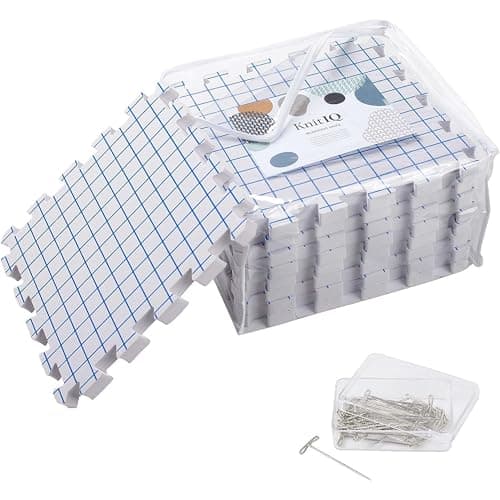
KnitIQ Blocking Mats
Gridded foam boards and T-pins, so a blocked swatch dries flat and square before you measure it.
$49.99 - View on Amazon$54.999% off · #ad disclosure - price as of October 20, 2026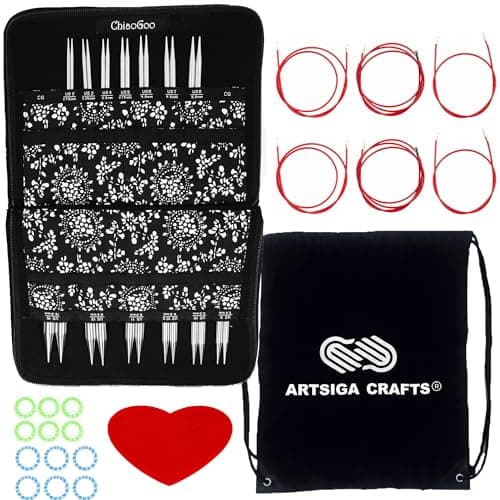
ChiaoGoo TWIST Red Lace Interchangeable Set (Complete, 5in tips)
Thirteen tip sizes on one set - the practical way to change needle size without buying another needle.
$216.80 - View on Amazon#ad disclosure - price as of October 20, 2026
Questions people actually ask
How do you measure knitting gauge?
Knit a swatch at least six inches square in the pattern stitch, wash and dry it the way you will treat the garment, then count the stitches and rows in four inches measured in the middle of the swatch.
What if my gauge has too many stitches?
Your stitches are too small, so go up a needle size. Too few stitches in four inches means they are too big, so go down. One size moves worsted-weight gauge by roughly half a stitch per four inches.
Do I need to block my gauge swatch?
Yes, for anything that will be washed. Superwash wool and alpaca can grow noticeably, and cotton shrinks slightly on its first wash. The blocked gauge is the one the finished garment will have.
How big should a gauge swatch be?
At least six inches square. Edge stitches are always distorted, so you need enough fabric to measure a clean four inches in the middle.
Does row gauge matter?
Less than stitch gauge in knitting, because most patterns are worked to a measured length. It matters more in crochet, where stitch heights vary sharply between stitch types and patterns depend on the row count.