Guide
Best Row Counters
The advantage of a mechanical counter is that nothing can interrupt it. That is the entire pitch.
By Sawyer V. · Published September 6, 2026
Disclosure: we earn a commission when you buy through the links on this page, at no extra cost to you. It never decides what we recommend or how we rank it - read the full disclosure.
The short answer
A mechanical push-top counter is the reliable option: it counts 0 to 99, needs no battery and cannot be interrupted. For long plain stretches, clipping a locking stitch marker into the fabric every ten rows is free and self-verifying - you can recount from the fabric if you lose track.
Why counting is hard in the first place
Row counting fails for one reason: it is a running total held outside the work. The knitting does not know what row it is on. You do, and only until something interrupts you.
Every counting method is an attempt to move that total out of your head and into something more reliable. They differ in how well they survive an interruption.
The methods, compared
| Method | Cost | Survives an interruption? | Fails by |
|---|---|---|---|
| Mechanical push counter | Low | Yes | Forgetting to press it |
| Phone app | Free | Partly | Notifications, lock screen, a dead battery |
| Locking markers in the fabric | Low | Yes, and it is recountable | Nothing, if you place them consistently |
| Tally on paper | Free | Yes | Losing the paper |
| Counting the rows in the knitting | Free | Yes | Slow, and hard in textured stitch patterns |
| Remembering | Free | No | Anything at all |
The mechanical counter
The Clover Kacha-Kacha - named for the noise it makes - is the reference. Push the top once per row; each push advances the count by one, from 0 up to 99. Reset by turning the gears in the direction of the arrows. ABS resin, no battery, nothing to charge.
Its advantage over a phone app is not accuracy. It is that a phone is an interruption machine: a notification arrives, you lose your place in two senses at once, and the app is no longer showing what you were looking at.
Its weakness is the same as every counter's - it only counts what you tell it. A forgotten press is invisible and unrecoverable, which is why we would pair one with markers on any long piece.
The marker method, which is free
Clip a locking stitch marker into the fabric every tenth row, at the edge. You now have a physical ruler running up your knitting.
- It is recountable. Lost track? Count the markers, multiply by ten, count the rows above the last one.
- It doubles as a measuring point. Patterns often say work until the piece measures X from the underarm - a marker at that point is the reference.
- It survives everything. Nothing to press, nothing to charge, nothing to knock.
- It costs nothing extra if you already own markers, which every knitter should - see best stitch markers.
The one thing it does not do is count a complex repeat. For lace with a twelve-row pattern, a counter or a written tally is better.
Matching the method to the project
- Plain stockinette or garter, long stretches: markers every ten rows. Nothing to forget.
- A stitch pattern with a repeat: a mechanical counter, reset at the start of each repeat, so it tells you where you are in the pattern rather than in the piece.
- Lace: both, plus a lifeline. Lace is where a miscount is most expensive - see best knitting needles for lace.
- Colorwork: the chart is the counter. Mark your place on the chart itself.
- Crochet in the round: a marker in the first stitch of the round, which is not optional - see best crochet hooks for amigurumi.
- Two identical pieces: count the first, write the number down, and knit the second to that number rather than to a measurement.
Why row gauge makes counting matter
Most patterns are written to a measured length rather than a row count - work until the body measures 15in - which sounds like it removes the need to count at all.
It does not, for two reasons. Shaping is always given in rows: decrease every 6th row, twelve times. And the second sleeve has to match the first, which is a row count rather than a measurement because the two will hang differently on a tape.
Our gauge and swatching page covers why row gauge is the one people ignore, and this is where ignoring it becomes visible.
What we would buy
- One counter: the Clover Kacha-Kacha. Mechanical, no battery, and it survives a project bag.
- The method we would use more: locking stitch markers every ten rows, because the count lives in the fabric.
- If you cable: stitch holders, so parked stitches are not a second thing to track.
Three ways to keep count
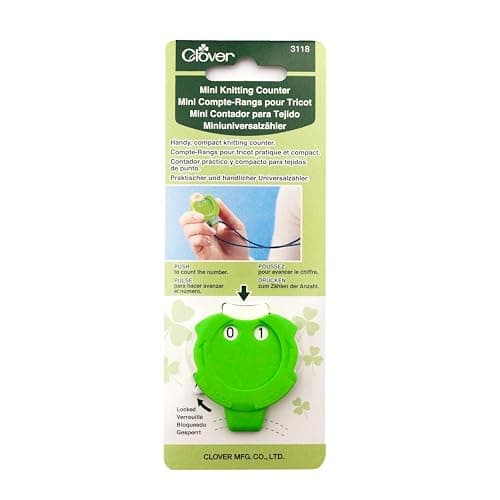
Clover Knitting Counter (Kacha-Kacha)
Push-top mechanical counter, 0 to 99, no battery and nothing to interrupt it.
$9.77 - View on Amazon#ad disclosure - price as of October 20, 2026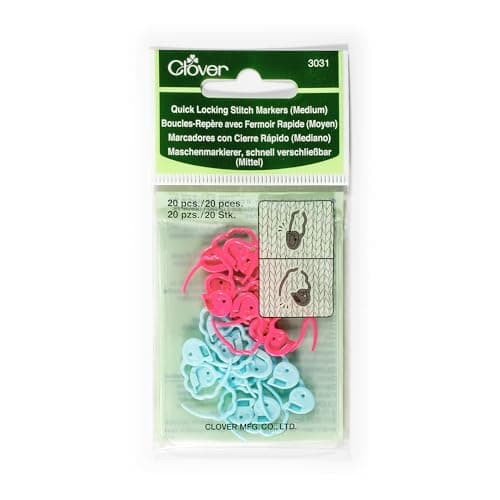
Clover Quick Locking Stitch Markers, Medium
The free-form method: clip a marker every ten rows and the fabric counts for you.
$8.00 - View on Amazon#ad disclosure - price as of October 20, 2026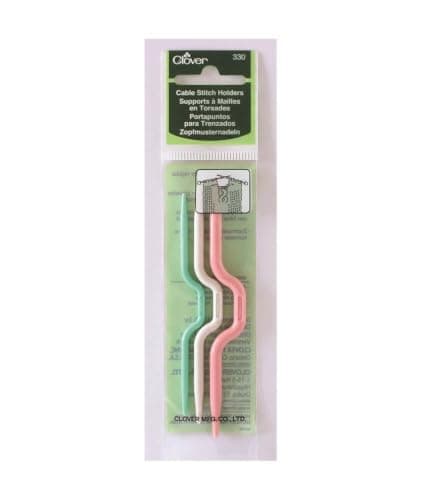
Clover Cable Stitch Holders (3-piece set)
The related problem - parking stitches you set aside, so you are not counting those too.
Questions people actually ask
Do I need a row counter?
Not strictly - clipping a locking stitch marker into the fabric every ten rows does the same job, costs nothing extra and can be recounted from the knitting. A mechanical counter is better for tracking your place inside a repeating stitch pattern.
What is a Kacha-Kacha counter?
A mechanical push-top row counter made by Clover, named after the sound it makes. Each push advances the count by one from 0 to 99, and it resets by turning the gears. It needs no battery.
Is a counter app as good as a physical counter?
Functionally yes, practically often not. A phone is an interruption machine - a notification takes you out of the app and out of your place at the same time. A physical counter has nothing else to do.
How do you count rows in knitting without a counter?
Clip a marker into the edge of the fabric every tenth row. Count the markers, multiply by ten, and add the rows above the last one. It is the only method you can verify against the actual knitting.
How do you make two sleeves the same length?
Count rows rather than measuring. Write down the row count of the first sleeve and knit the second to that number - two pieces of knitting will hang differently against a tape measure even when they are identical.