Guide
Best Hook for Fingering Weight Yarn
Thin, hard-spun and unforgiving. Fingering is where a vague hook stops being good enough.
By Sawyer V. · Published September 6, 2026
Disclosure: we earn a commission when you buy through the links on this page, at no extra cost to you. It never decides what we recommend or how we rank it - read the full disclosure.
The short answer
Use a 2.5mm to 3.5mm hook for fingering weight, with 3.0mm as the default. Fingering yarn is tightly plied and its stitches are small, so you want a hook with a defined head and fine size steps - and a comfortable grip, because a fingering project is several times as many stitches as the same object in worsted.
What fingering weight is
Fingering is category 1 - super fine - in the Craft Yarn Council system, the weight most sock yarn is sold in. Patons Kroy Socks is the reference example here: 75% washable wool with 25% nylon, 166yd per 50g ball, quoted at 22 single crochets over 4in on a 3.25mm hook.
The names overlap confusingly. Fingering, sock, 4-ply and super fine all describe the same band. Below it is lace weight; above it is sport.
Sizes, and why the band figure is only a start
| Project | Hook | Why |
|---|---|---|
| Shawls and lace | 3.5-4.0mm | Openwork needs a loose fabric to show the pattern |
| General fabric | 3.0-3.25mm | The band figure; a balanced fabric |
| Socks | 2.5-2.75mm | Dense enough to survive abrasion inside a shoe |
| Amigurumi in fingering | 2.0-2.5mm | Tight enough that stuffing does not show |
| Thread-like edging | 1.5-2.0mm | Steel territory - see below |
The spread there is nearly three millimeters for one yarn weight, which is why a single recommended hook size on a ball band tells you much less than it appears to.
Head shape matters more at this gauge
At worsted weight, the in-line versus tapered difference is a preference. At fingering it is closer to a requirement, in both directions.
Small stitches are small holes. An in-line head keeps a consistent diameter, so it goes into a 2.5mm stitch at the size you expect. A tapered throat has to widen the stitch first, and at this scale that is a real amount of extra force per stitch.
Hard-spun yarn splits less. Sock yarn is spun tightly for abrasion resistance, which is the property that makes tapered heads useful elsewhere. Here it matters less, so the in-line advantage wins on balance.
Fine size steps are worth paying for
Most hook sets step in 0.5mm increments: 2.25, 2.5, 3.0, 3.5. At worsted weight that is a small relative change. At 2.5mm, moving to 3.0mm is a twenty percent change in stitch size, which can be more adjustment than you wanted.
The Tulip Etimo Rose set is the one in our registry that steps 2.00, 2.20, 2.50, 3.00mm - a 0.2mm step at the bottom. That granularity is genuinely useful when a sock is coming out half a size wrong.
Where fingering ends and thread begins
Below about 2mm you have left yarn hooks behind. Aluminum sets stop at 2.25mm, and thread work runs from 1.5mm down. That is steel hook territory, where the numbering runs backwards and the tools are a different category.
You will meet this boundary if you crochet edgings onto fine fabric, or if you follow a vintage pattern - a great many of them assume size 10 thread and a 1.5mm hook.
Comfort is not optional here
This is the part worth being blunt about. A crocheted sock in fingering weight is on the order of ten thousand stitches. The same sock's worth of surface area in worsted is a fraction of that.
A bare aluminum hook is fine for a dishcloth and punishing over a fingering-weight garment. Every recommendation on this page except the steel set has a molded or cushioned grip for that reason, and our ergonomic hooks and arthritis pages make the same case from the other direction.
Crochet eats more yarn than knitting
Worth knowing before you buy the yarn: crochet uses roughly a third more yarn than knitting for the same fabric area, because each stitch wraps more times.
A knitted sock pattern calling for 400yd of fingering becomes 500 to 550yd in crochet. At 166yd per ball that is an extra ball, and buying it later risks a different dye lot. The yardage page has the arithmetic.
What we would buy for fingering weight
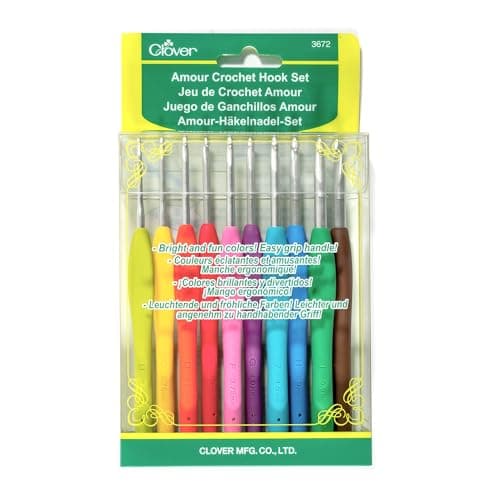
Clover Amour Crochet Hook Set
Covers B/2.25mm to J/6.0mm with a grip you can hold for hours - and fingering takes a lot of hours.
$49.91 - View on Amazon#ad disclosure - price as of October 21, 2026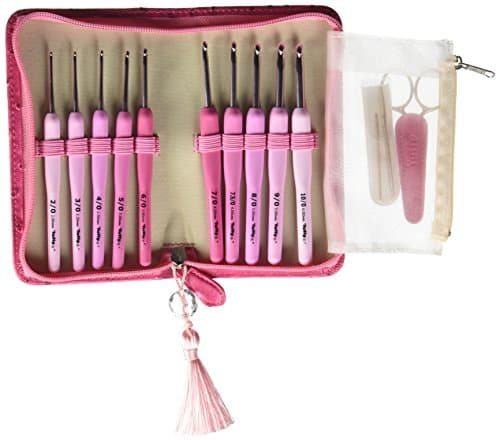
Tulip Etimo Rose Crochet Hook Set
The finest steps of any yarn-size set: 2.00, 2.20, 2.50, 3.00mm, which is exactly the fingering range.
$117.00 - View on Amazon#ad disclosure - price as of October 21, 2026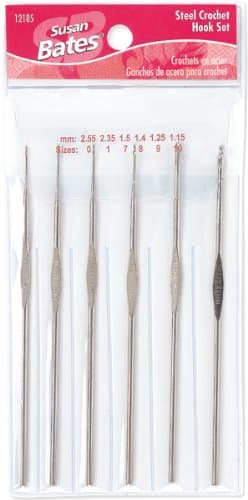
Susan Bates Steelite Steel Crochet Hook Set
Below 2mm, where fingering shades into thread work - six nickel-plated steel hooks from 1.15mm.
$7.95 - View on Amazon#ad disclosure - price as of October 21, 2026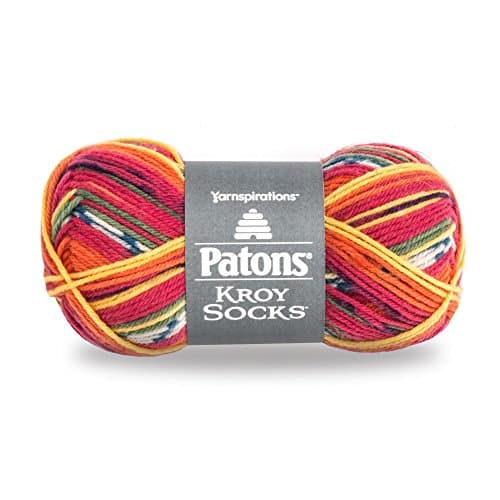
Patons Kroy Socks
The fingering yarn most of this page is written about: 75% wool, 25% nylon, 166yd per 50g.
$9.99 - View on Amazon#ad disclosure - price as of October 21, 2026
Questions people actually ask
What size crochet hook for fingering weight yarn?
3.0mm as a default. Use 2.5mm to 2.75mm for socks where you want a dense fabric, and 3.5mm to 4.0mm for shawls and lace where the openwork needs room.
What is fingering weight yarn?
Category 1, super fine, in the Craft Yarn Council system - the weight most sock yarn is sold in. Fingering, sock, 4-ply and super fine all describe the same band.
Are in-line or tapered hooks better for fine yarn?
In-line, on balance. Fine stitches are small holes and an in-line head keeps a consistent diameter through them, while a tapered throat has to widen each stitch first - which is real extra force at this scale.
Can I use a steel hook for fingering weight yarn?
At the top of the steel range, yes - a 2.55mm steel hook works on fingering. Below about 2mm the hooks are made for crochet thread, not yarn, and a fingering yarn will not seat properly.
How much fingering yarn does a crochet project take?
Roughly a third more than the knitted equivalent, because each crochet stitch wraps the yarn more times. A pattern calling for 400 yards knitted needs 500 to 550 yards crocheted.