The picks
Best Crochet Hook for Arthritis
A thicker handle needs less pinch force. Start there, and change how you work too.
By Sawyer V. · Published September 4, 2026
Disclosure: we earn a commission when you buy through the links on this page, at no extra cost to you. It never decides what we recommend or how we rank it - read the full disclosure.
The short answer
Choose the largest handle diameter your hand can control, because a thicker handle needs less pinch force to hold securely. Furls Streamline publishes the largest figure at 16 to 17mm; the Clover Amour set is the practical choice if you want that comfort across every size. Then change how you work - the technique changes matter as much as the hook.
| # | Product | Best for | Head | Sizes | Price |
|---|---|---|---|---|---|
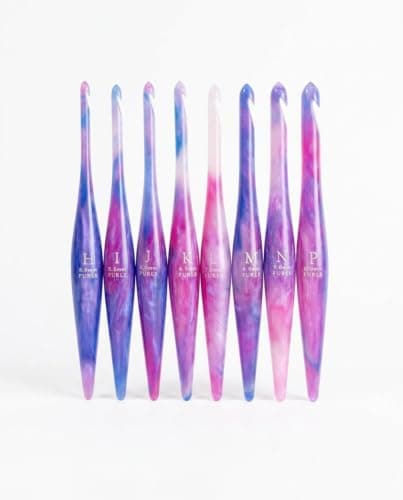
| 1 | Furls Streamline Resin Crochet Hook16 to 17mm at the widest point - the largest published diameter here. | The thickest handle available | Furls profile | H/5.0 - P/10.0mm, single hooks | $34.99 - View on Amazon#ad disclosure - price as of October 20, 2026 |
| 2 | 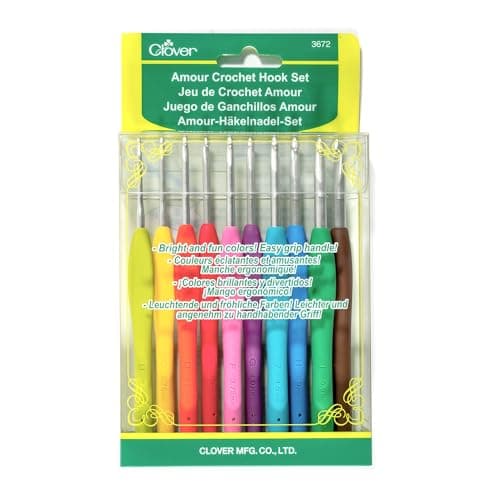 Clover Amour Crochet Hook SetA soft elastomer grip on all ten sizes, so no project forces you back to bare metal. Clover Amour Crochet Hook SetA soft elastomer grip on all ten sizes, so no project forces you back to bare metal. | Comfort across every size you use | Rounded | B/2.25 - J/6.0mm | $50.83 - View on Amazon#ad disclosure - price as of October 20, 2026 |
| 3 | 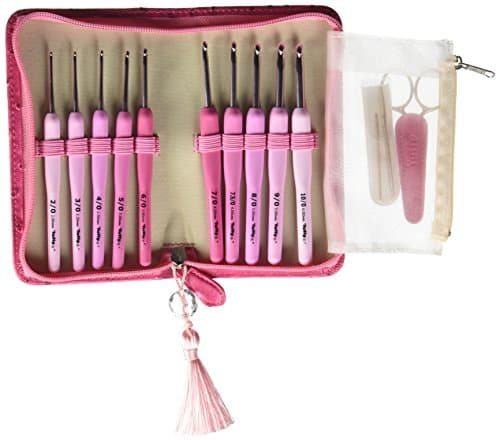 Tulip Etimo Rose Crochet Hook SetA softer cushion than the Clover, and unusually fine size steps. Tulip Etimo Rose Crochet Hook SetA softer cushion than the Clover, and unusually fine size steps. | Sensitive joints at small hook sizes | Tulip profile | 2.00 - 6.00mm | $117.00 - View on Amazon#ad disclosure - price as of October 20, 2026 |
| 4 | 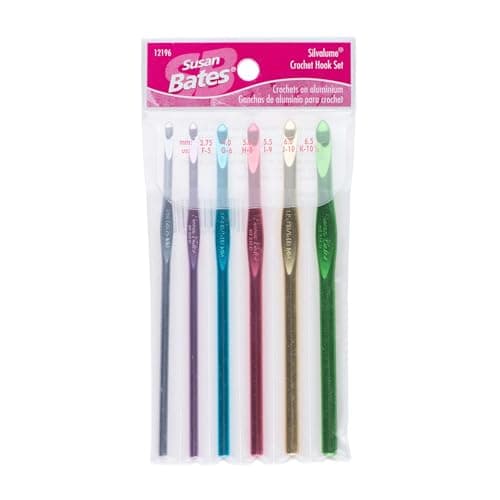 Susan Bates Silvalume Aluminum Crochet HooksA good hook with no handle - every gram of grip comes from your fingers. Susan Bates Silvalume Aluminum Crochet HooksA good hook with no handle - every gram of grip comes from your fingers. | Not painful hands | In-line | B-1/2.25 - N-15/10mm | $11.57 - View on Amazon#ad disclosure - price as of October 20, 2026 |
Furls Streamline Resin Crochet Hook
Furls · Best for the thickest handle available
A single hand-poured resin hook with a 16-17mm handle - roughly the diameter of a fat marker pen, sold one size at a time.
- Handle diameter
- 16-17mm at the widest point
- Length
- About 6.75in
- Material
- Hand-poured resin, made in India
- Sizes
- H/5.00mm up to P/10.00mm depending on release
- Sold as
- Single hook, not a set
Who it suits
Anyone who finds a standard cushioned hook still too thin to hold without gripping hard.
Why it is here
Hand-poured resin at about 6.75in long and 16-17mm at its widest. Handle diameter is the variable that reduces required pinch force, and this is the only hook here that publishes the figure.
What you give up
Sold one hook at a time, so a working range is expensive. Resin is also warmer in the hand than metal, which most people find pleasant and some do not.
Specifications from Furls Streamline collection page. We have not handled this item - see how we pick.
Clover Amour Crochet Hook Set
Clover · Best for comfort across every size you use
Ten aluminum hooks with a molded elastomer grip, covering 2.25mm to 6.0mm - the whole span most patterns for worsted and DK yarn ever ask for.
- Sizes
- 10 hooks: B/2.25mm to J/6.0mm
- Grip
- Elastomer rubber, latex free
- Shaft
- Aluminum
- Head
- Rounded, between inline and tapered
- Color coding
- Handle color differs per size
Who it suits
Anyone who wants consistent comfort across a working range rather than one comfortable hook.
Why it is here
Elastomer rubber handles on aluminum shafts, B/2.25mm to J/6.0mm, latex free. Buying comfort as a set matters, because a single ergonomic hook still leaves you holding bare metal for every other size.
What you give up
The grip is thinner than the Furls, and the set stops at 6.0mm - bulky yarn means a separate hook.
Specifications from Clover USA product page. We have not handled this item - see how we pick.
Tulip Etimo Rose Crochet Hook Set
Tulip · Best for sensitive joints at small hook sizes
Ten cushion-grip hooks from 2.00mm to 6.00mm, made in Hiroshima, with the finest size steps of any set here.
- Sizes
- 10 hooks: 2.00, 2.20, 2.50, 3.00, 3.50, 4.00, 4.50, 5.00, 5.50, 6.00mm
- Grip
- Cushioned rubber grip
- Head
- Polished tip, Tulip's own hook profile
- Also included
- Two darning needles, scissors, zipped case
- Made in
- Hiroshima, Japan
Who it suits
Anyone whose hands are worst at fine gauges, where the hook is smallest and the grip force highest.
Why it is here
Cushioned rubber grip that the maker describes as reducing the load on the fingers, across 2.00 to 6.00mm with steps most sets skip. The fine-size coverage matters here because small hooks are where hands work hardest.
What you give up
The most expensive full set here, and it includes accessories you may not need.
Specifications from Tulip Etimo Rose set specification. We have not handled this item - see how we pick.
Susan Bates Silvalume Aluminum Crochet Hooks
Susan Bates · Best for not painful hands
The bare aluminum inline hook that a large share of American crocheters learned on, and still the cheapest way to find out which head shape suits you.
- Head
- In-line (head sits flush with the shaft)
- Material
- Anodized aluminum, heat treated and polished
- Size range
- B-1/2.25mm through N-15/10mm
- Length
- 5.5in for B through K; longer for L, M, N
- Color coding
- One color per size
Who it suits
Not for anyone buying for joint pain. It is here because bare aluminum hooks are the most-recommended budget option and they are the wrong answer to this question.
Why it is here
Anodized aluminum, heat treated and polished, with an in-line head and no grip at all - roughly pencil diameter, 5.5in through size K. It is a genuinely good hook and a large share of American crocheters learned on it. It simply does nothing for your hands.
What you give up
If you already own a bare set, foam pencil grips slid onto the shafts increase the diameter for a few cents. Try that before buying anything.
Specifications from Susan Bates Silvalume retail specification. We have not handled this item - see how we pick.
Why diameter is the variable
Holding a thin cylinder securely requires more pinch force than holding a thick one. Sustained pinch force is what loads the thumb joint and the small muscles of the hand, and it is the mechanical demand that crochet places on you continuously for as long as you work.
Increasing handle diameter reduces that force requirement directly. That is the entire reason ergonomic hooks exist, and it is why the published diameter is the specification worth comparing - even though most manufacturers do not publish it.
Weight, which people overlook
A lighter hook is less to support, and support is a continuous low-level load rather than an intermittent one. Aluminum hooks are very light; resin hooks are heavier than they look. There is no universally right answer - some people find a little weight helps them relax their grip, others find any extra weight tiring. It is worth trying both if the first attempt does not help.
The changes that help as much as the hook
- Go up a hook size and loosen your tension. Tight crochet requires more force at every single stitch. This is free and it is usually the largest single improvement available.
- Change your hold. Pencil grip and knife grip load different structures. Switching between them within a session spreads the load.
- Shorter sessions. Twenty minutes, then a stretch, then twenty more. Continuous work is what accumulates strain.
- Warm hands first. Warmth before you start is a widely-used and very cheap intervention for stiff joints.
- Choose yarn that does not fight you. Smooth, tightly-plied worsted needs less force than splitty or grabby yarn - see best hook for acrylic yarn.
- Larger hooks and bulkier yarn. Fewer stitches for the same finished area is less total work. A blanket in bulky yarn is far fewer stitches than the same blanket in worsted.
- Stop when it hurts. Pain is information, not weakness.
Adapting hooks you already own
Before spending anything, two cheap options that genuinely work:
- Foam pencil grips. Slide one onto the shaft of a bare aluminum hook and you have increased the diameter for a few cents. This is the single cheapest test of whether diameter is your problem.
- Polymer clay handles. Some crocheters mold a custom handle around a plain hook. It gives you a diameter and shape matched to your own hand, which no commercial hook can.
If either helps, you have learned that grip diameter is your issue and you can buy accordingly. If neither helps, the problem may be tension, hold or session length rather than the hook.
Knitting instead?
Sometimes the honest answer is that the other craft suits your hands better. Knitting distributes work across two hands and both wrists rather than concentrating it in one hand's pinch grip; some people with hand pain find it easier, and some find the opposite.
It costs one skein and one pair of needles to find out. Best knitting needles for arthritis covers the equivalent equipment, and knitting vs crochet compares the two crafts properly.
How we picked
We ranked on published handle diameter where a manufacturer states it, and on grip material and size coverage where they do not. We have not held any of these hooks and we make no claim about how any of them feels in a painful hand. How we pick is the method.
Questions people actually ask
What is the best crochet hook for arthritis?
The one with the largest handle diameter you can control, because that needs the least pinch force. Furls Streamline publishes the largest figure at 16 to 17mm; the Clover Amour set gives you a cushioned grip across every size.
Do ergonomic hooks help with arthritis?
They reduce the pinch force needed to hold the hook, which is a real mechanical improvement. They do not treat the condition, and technique changes usually help as much as equipment.
Can I make my existing hooks easier to hold?
Yes. A foam pencil grip slid onto the shaft increases the diameter for a few cents, and it is the cheapest way to find out whether diameter is your problem.
Is crochet or knitting better for arthritis?
It varies by person and by which joints are affected. Crochet concentrates work in one hand's pinch grip; knitting spreads it across both hands and wrists. Trying the other craft costs one skein and one pair of needles.
Should I keep crocheting if my hands hurt?
Stop when it hurts, and get an assessment rather than working through it. An occupational therapist or hand specialist can look at your specific joints, which is something no product recommendation can do.