Head to head
Ergonomic vs Aluminum Crochet Hooks
The difference is one property - diameter - and it decides whether your hand lasts the blanket.
By Sawyer V. · Published September 27, 2026
Disclosure: we earn a commission when you buy through the links on this page, at no extra cost to you. It never decides what we recommend or how we rank it - read the full disclosure.
The short answer
Buy a gripped hook if you crochet for more than about an hour at a time, and a bare aluminum one if you do not. The mechanism is diameter: a thin cylinder has to be pinched harder to hold securely than a thick one, and sustained pinch force is what produces the ache in the thumb web. Everything else about the two is close enough not to matter. Before spending anything, slide a foam pencil grip onto a hook you own and crochet a swatch.
What the handle actually does
A bare aluminum hook is roughly pencil diameter along its whole length. An ergonomic hook takes the same metal shaft and wraps a thick molded handle around the part your fingers hold.
The hook end is unchanged. The head shape, the throat, the size, the smoothness - all the things that decide how the hook meets the yarn - are the same on both. You are buying a different thing to hold, not a different thing to crochet with.
The comparison
| Bare aluminum | Ergonomic | |
|---|---|---|
| Handle | None - the shaft is the handle | Molded rubber, elastomer or resin |
| Diameter held | Roughly pencil thickness | Substantially wider |
| Price band | Lowest in the category | Several times more |
| Size range available | Full, 2.25mm to 10mm and beyond | Usually narrower |
| Weight | Very light | Slightly heavier |
| Head geometry | Same options | Same options |
| Best for | Short sessions, odd sizes, trying a size | Long sessions, blankets, any hand pain |
Who should buy which
- Any history of joint pain: gripped, immediately. This is not a comfort upgrade, it is the reason the category exists - see best crochet hook for arthritis.
- Blanket and garment crocheters: gripped. Those are the longest sittings anyone does.
- Amigurumi at tight tension: gripped. Tight work needs more force per stitch, which is the same problem from a different direction.
- Occasional crocheters: bare is fine. A dishcloth on a Sunday does not need a handle.
- Anyone who needs one odd size once: bare. Buying a premium hook for a single project is money better spent on yarn.
- Anyone unsure: test first. The foam grip trick below costs almost nothing.
The test that costs nothing
Slide a foam pencil grip onto a bare hook you already own and crochet a full swatch with it. If your hand is noticeably better, diameter is your problem and a gripped hook will fix it properly. If nothing changes, the handle is not what is bothering you and you can stop shopping.
This is the cheapest diagnostic in the craft, and it also tells you roughly how thick you need. If a thin foam grip helps a little, a thicker resin handle will help more.
What a grip does not fix
- Splitting yarn. That is head geometry - see inline vs tapered crochet hooks.
- Uneven tension. That is practice.
- Wrist pain from posture. A handle changes your fingers, not how you sit.
- Persistent pain that does not respond to any of this. That is a question for a clinician, not a new hook.
The three grip materials
Gripped hooks are not one thing. The three constructions on this site behave differently, and the differences matter more than brand.
| Type | Example | Feel | Published width |
|---|---|---|---|
| Molded elastomer | Clover Amour | Slightly yielding, latex free | Not published as a figure |
| Cushioned soft grip | Tulip Etimo Rose | Softest of the three | Not published as a figure |
| Hand-poured resin | Furls Streamline | Rigid, thickest by far | 16-17mm at widest point |
The resin one is the interesting case, because it is the least cushioned and the most recommended for serious hand pain. That is the clearest evidence on this page that thickness rather than softness is doing the work.
Where bare aluminum genuinely wins
It is not only about price. Bare hooks are made in a wider size range than most gripped lines - the Susan Bates range runs from B-1/2.25mm to N-15/10mm - so for an unusual size the bare hook may be the only option. They are lighter, they take up no room, and losing one costs nothing.
Best ergonomic crochet hooks covers the gripped options, and best budget crochet hooks the cheap end.
Both kinds
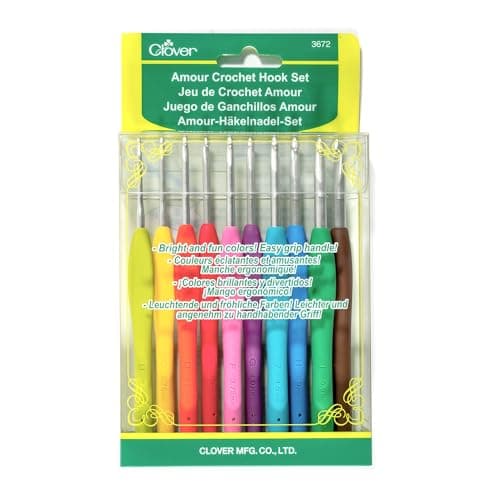
Clover Amour Crochet Hook Set
The gripped reference: ten aluminum hooks, B/2.25mm to J/6.0mm, with a molded elastomer rubber grip, latex free.
$48.66 - View on Amazon#ad disclosure - price as of September 27, 2026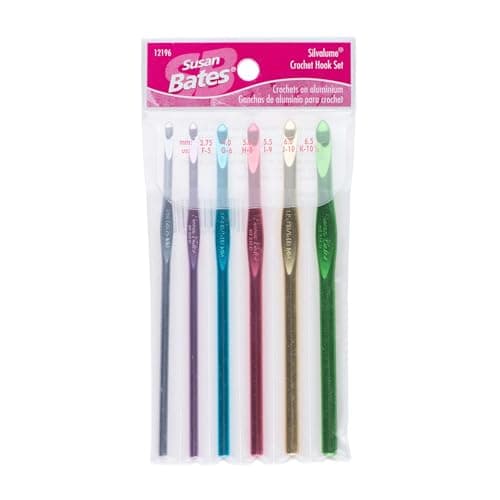
Susan Bates Silvalume Aluminum Crochet Hooks
The bare reference: anodized aluminum, in-line head, B-1/2.25mm to N-15/10mm, color coded by size.
$8.75 - View on Amazon$9.286% off · #ad disclosure - price as of September 27, 2026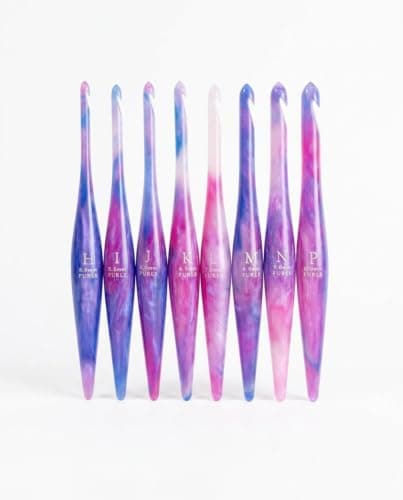
Furls Streamline Resin Crochet Hook
The extreme of the gripped end: a hand-poured resin handle 16-17mm at its widest, about 6.75in long.
$34.99 - View on Amazon#ad disclosure - price as of September 27, 2026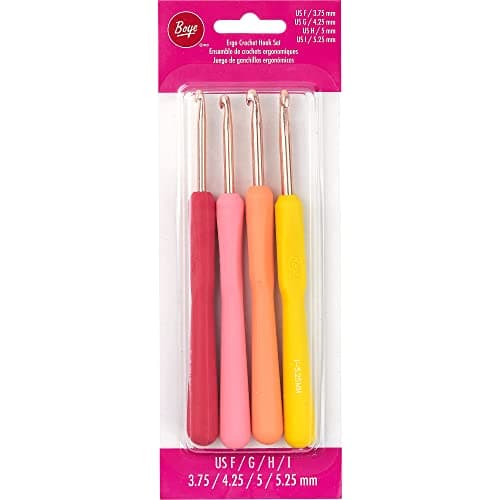
Boye Ergonomic Crochet Hook Set, Light and Medium Yarn (40-40044)
The middle: Boye's tapered throat with a molded ergonomic handle, four hooks F/3.75mm to I/5.25mm.
$16.32 - View on Amazon#ad disclosure - price as of September 27, 2026
Questions people actually ask
Are ergonomic crochet hooks worth the money?
If you crochet for more than about an hour at a stretch, or have any joint pain, yes. A wider handle needs less pinch force to hold, and sustained pinch force is what causes the ache. For occasional short projects, a bare aluminum hook is genuinely fine.
Do ergonomic hooks crochet differently?
No. The head, throat and size are unchanged - you are buying a different thing to hold, not a different thing to crochet with. Head geometry, not the handle, is what decides how the hook meets the yarn.
Is a softer handle better?
Diameter matters more than softness. The widest handle on this site is rigid resin, and it is the one recommended for the worst hand pain. Cushioning is comfort; thickness is what reduces the load.
How can I tell if I need an ergonomic hook?
Slide a foam pencil grip onto a hook you already own and crochet a full swatch. If your hand is noticeably better, diameter is your problem. If nothing changes, a new handle will not help.
Will an ergonomic hook stop my yarn splitting?
No. Splitting is caused by the head geometry - an in-line head enters between plies more readily than a tapered one. The handle has nothing to do with it.