Guide
Best Crochet Hooks for Garments
A scarf forgives a drifting gauge. A sleeve does not. That changes which hook you want.
By Sawyer V. · Published September 12, 2026
Disclosure: we earn a commission when you buy through the links on this page, at no extra cost to you. It never decides what we recommend or how we rank it - read the full disclosure.
The short answer
For a garment, pick a hook with a grip you can hold for hours and then use that exact hook for the whole project. Consistency matters far more than which head shape you chose: a sweater is thousands of stitches that all have to match, and switching hooks mid-project changes your gauge. Buy a second hook in the same size and brand as insurance.
Why a garment is a different problem
A blanket can drift half a stitch per inch and nobody will ever know. A sweater cannot - the front and the back have to be the same width, the sleeves have to be the same length, and the gauge you swatched has to hold for the entire piece.
That reframes the hook question. For a scarf, buy the hook that feels nicest. For a garment, buy the hook that you can keep using identically for twenty hours, and then do not change it.
Head shape, for a long project
The site's general head-shape argument is in inline vs tapered crochet hooks. What changes for garments is the consequences of each.
| Head | Over a garment | Watch for |
|---|---|---|
| In-line | Very consistent - the loop always sits on one diameter | Splits soft singles |
| Tapered | Grabs the loop positively; fewer split stitches | Slightly more tension variation |
| Rounded | The usual compromise | Nothing in particular |
In-line is the more consistent geometry over a long piece, because the working loop cannot migrate onto a wider shoulder. That is a real if small advantage for garments specifically.
Grip, because of the hours
- A garment is a long-session project. The hook that is fine for twenty minutes may not be fine for two hours.
- A wider handle needs less pinch force, which is the mechanism behind every ergonomic hook.
- Test before committing. Crochet a full swatch's worth in one sitting before starting a sweater with a hook you have not used at length.
- Hand pain changes the answer entirely - see best crochet hook for arthritis.
Gauge, which is the whole project
- Swatch large. At least 6in square for a garment, so you are measuring an average rather than an edge.
- Wash and block the swatch and measure it after, because that is the fabric the garment will be.
- Measure in the middle, never at the edges.
- Re-measure after the first few inches of the actual garment. Swatch tension and project tension differ for most people.
- Write the hook down. The exact hook, not just the size - see how to read a yarn label for where to keep that note.
The full method is in knitting gauge and swatching; crochet gauge works identically, only the stitch names change.
Size range matters more than it looks
Garment patterns routinely specify two hooks - a main size for the body and a smaller one for ribbing, cuffs and edgings. A set that covers both is worth more than a single premium hook.
Check the set's range against the pattern before buying. Ten-hook sets that stop at 6.0mm cover almost all DK and worsted garments; anything in bulky needs a hook bought separately.
What not to use for a garment
- A mixed bag of hooks. Different brands in the same nominal size are not the same hook.
- A hook you have not swatched with. The swatch is only valid for the hook that made it.
- Steel thread hooks. Wrong scale entirely - see best steel crochet hooks.
- A borrowed hook. You will have to give it back mid-sleeve.
The rest of the setup
Garments need markers at the shaping points, a blunt needle for a great many ends, and a way of keeping the pieces flat while you work the second one. Two of those come in the Tulip set above; the third is best blocking mats.
What we would crochet a garment with
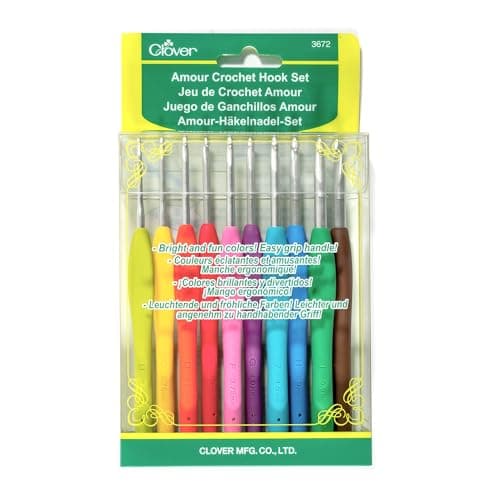
Clover Amour Crochet Hook Set
Ten hooks, B/2.25mm to J/6.0mm, elastomer grip, rounded head. The size range covers essentially every DK and worsted garment pattern.
$46.30 - View on Amazon$49.156% off · #ad disclosure - price as of September 21, 2026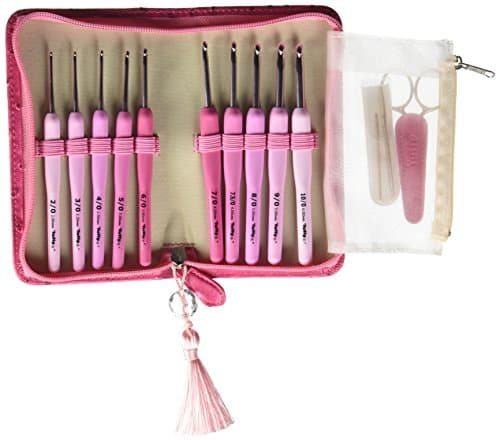
Tulip Etimo Rose Crochet Hook Set
Ten cushion-grip hooks in 2.00 to 6.00mm, marked in millimeters only - and it includes the darning needles a garment's ends will need.
$117.00 - View on Amazon#ad disclosure - price as of September 21, 2026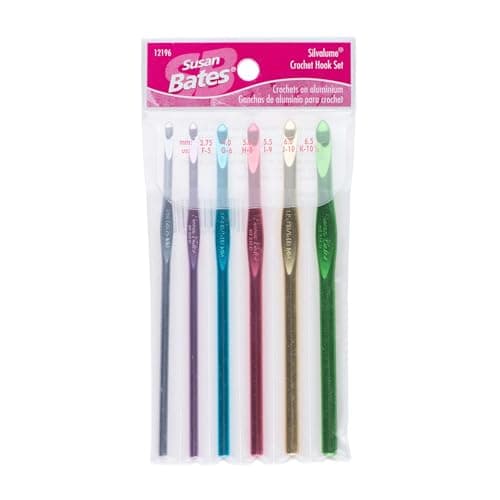
Susan Bates Silvalume Aluminum Crochet Hooks
The cheap spare. Buy a second hook in your garment's size so a lost hook does not end the project.
$8.75 - View on Amazon$9.296% off · #ad disclosure - price as of September 21, 2026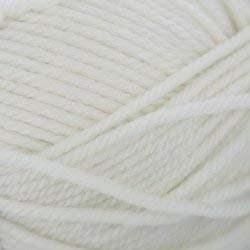
Cascade 220 Superwash Merino
The yarn a garment gauge is usually measured in - 100% superwash merino, 220yd per 100g, DK to light worsted.
$21.00 - View on Amazon#ad disclosure - price as of September 21, 2026
Questions people actually ask
What crochet hook is best for making clothes?
Whichever one you can hold comfortably for hours - and then that exact hook for the whole project. Consistency matters more than head shape on a garment, because the front, the back and both sleeves all have to match.
Should I buy two of the same crochet hook?
For a garment, yes. It is weeks of work at one gauge, hooks get lost, and finishing a second sleeve on a different hook will show. A spare costs very little.
Is in-line or tapered better for garments?
In-line is marginally more consistent over a long piece, because the working loop always sits on a single shaft diameter and cannot migrate onto a wider shoulder. Tapered splits fewer stitches. Either works; changing mid-project does not.
How big should a crochet swatch be for a garment?
At least 6in square, washed and blocked before you measure, and measured in the middle rather than at the edges. Then check your gauge again after the first few inches of the real garment.
Do I need more than one hook size for a sweater?
Usually yes - most garment patterns use a main size for the body and a smaller one for ribbing, cuffs and edgings. Check the pattern's sizes against the range of any set before buying.