Guide
Interchangeable Cables, Keys and Connectors
The set is the tips. The parts that decide how it works are the small things in the pocket.
By Sawyer V. · Published September 7, 2026
Disclosure: we earn a commission when you buy through the links on this page, at no extra cost to you. It never decides what we recommend or how we rank it - read the full disclosure.
The short answer
An interchangeable set is tips plus cables plus small parts: a key that tightens a screw join, end stoppers that hold live stitches, and a connector that joins two cables into one longer one. Brands are generally not compatible with each other. Buy spare cables in the lengths you use and a spare key if your system needs one.
What is actually in the case
| Part | Job | Lose it and... |
|---|---|---|
| Tips | The needle itself - a pair per size | You have a size gap |
| Cables | Hold the stitches between the tips | You lose a length, not a size |
| Key or tightening tool | Grips the join so a screw connection can be tightened | Screw joins work loose mid-row |
| End stoppers | Cap a cable so live stitches cannot escape | You cannot park a project on a cable |
| Connector | Joins two cables into one longer one | You buy a longer cable instead |
| Case | Keeps the tips in size order | You own tips you cannot find |
Two join types, and the practical difference
Screw joins - ChiaoGoo, Knitter's Pride - thread the tip onto the cable, and a small key gives you the leverage to tighten it properly. The join is very secure and it is the one that works loose if you do not use the key.
Click joins - addi - twist and lock with no threading and no tool. Faster, nothing to lose, and slightly bulkier at the join.
Do brands mix? Mostly no
This is the question people ask after buying a second set, and the honest answer is that you should assume incompatibility.
- Thread pitch and diameter differ between manufacturers, so a screw tip from one brand will not seat correctly on another's cable even when it starts to turn.
- Click systems are proprietary by design and do not interoperate at all.
- Within a brand, lines usually do mix - a manufacturer's own tips and cables are generally cross-compatible across their range, sometimes with a size caveat at the small end.
- Third-party adapters exist and are a compromise. They add length and another point of failure at the join, which is the last place you want one.
Practically: pick a system and stay in it. That is the strongest argument for buying a complete set rather than accumulating pieces, and it is covered in best interchangeable knitting needle sets.
Which spares are worth buying
- A second cable in your most-used length. The real value of an interchangeable set is having two projects live at once, and that needs two cables, not two sets of tips.
- End stoppers, several. They are what let you take the tips off a project and use them elsewhere. Sets ship with two; four is more useful.
- A spare key. Small, cheap, easy to lose, and the set is much less pleasant without one.
- A longer cable than you own. Most sets top out at 40in and a blanket wants more - see best needles for blankets.
- Not more tips. Size gaps are rare in a complete set. Length gaps are constant.
Cable care
Cables outlive tips if you look after them, and the failure modes are predictable.
- Store them straight or loosely coiled. A cable stored tightly wound takes a set, which is memory you have added yourself.
- Never yank a stuck join. Twisting a tip against a seized cable is how a cable's metal fitting separates from its nylon coating.
- Hot water relaxes a coil. A few seconds in hot - not boiling - water and then hung straight fixes most temporary memory.
- Retire a cable that has kinked. A permanent kink snags a stitch every pass and it will not come out.
- Keep them out of the stash bin. They tangle with everything - see best yarn storage solutions.
The stopper trick most people miss
End stoppers are usually thought of as a way to park a half-finished project. They do something more useful than that.
Cap both ends of a cable and you have a stitch holder that costs nothing extra - live stitches for a sleeve or a pocket, held safely, on a cable you were not using. It is tidier than waste yarn and the stitches stay oriented correctly, which waste yarn does not guarantee.
When fixed circulars are the better buy
Interchangeables are not automatically the right answer, and it is worth saying so.
- 16in and shorter cannot be made from most interchangeable systems, because the two tips alone are 10in. Hats need a fixed 16in.
- One size, used constantly - a sock knitter who works 2.5mm and nothing else - does not need a set.
- Nothing to work loose. A fixed circular has no join to retighten and no key to lose.
- Cost, for a small range. Three fixed circulars cost far less than any set.
Our cable lengths page covers which lengths a project needs; this page is about the hardware that delivers them.
Sets, and the parts that come with them
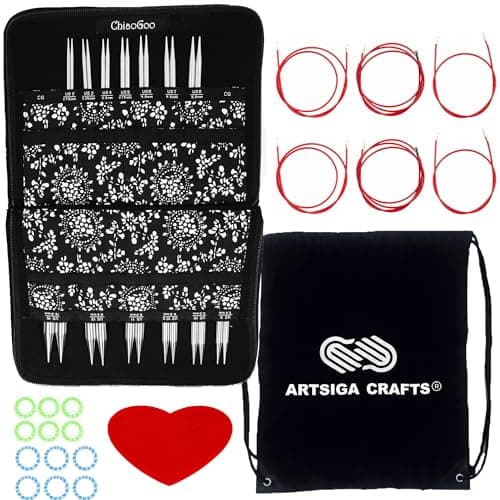
ChiaoGoo TWIST Red Lace Interchangeable Set (Complete, 5in tips)
Screw-and-key join on memory-free steel cables, with lifeline holes drilled through every tip.
$216.80 - View on Amazon#ad disclosure - price as of October 22, 2026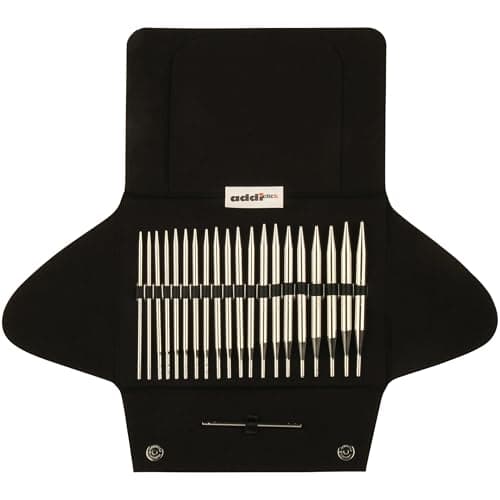
addi Click Turbo Interchangeable Needle Set
A keyless twist-and-click join - the fastest tip change of any system here, and no key to lose.
$216.00 - View on Amazon#ad disclosure - price as of October 22, 2026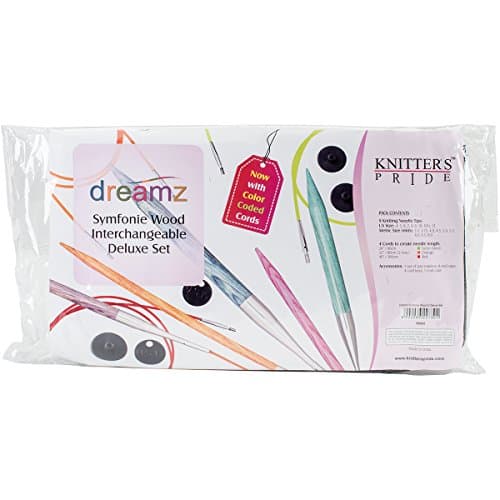
Knitter's Pride Dreamz Deluxe Interchangeable Set
Nylon-coated stainless cables with 360-degree swivel connectors, which stop the cable winding up.
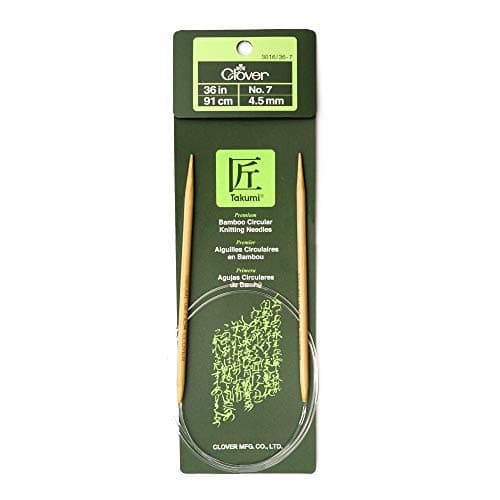
Clover Takumi Bamboo Circular Needles
The alternative to the whole question: fixed circulars, one size and length per pack, nothing to unscrew.
$9.86 - View on Amazon#ad disclosure - price as of October 22, 2026
Questions people actually ask
Are interchangeable knitting needle cables universal?
No. Thread pitch and diameter differ between manufacturers and click systems are proprietary, so assume that one brand's tips will not fit another's cables. Within a brand, lines usually do mix.
What is the key that comes with a needle set for?
It gives you leverage to tighten a screw join properly. Finger-tight is not tight enough - the act of knitting rotates the tip against the cable, so a screw join works loose without one.
Why does my interchangeable needle keep coming unscrewed?
Because knitting rotates the tip against the cable. It is normal rather than a fault. Retighten with the key every few hours, and always with the key rather than your fingers.
What are cable connectors used for?
Joining two cables into one longer one. It is the cheap way to get a 60in cable for a blanket if you already own a 32in and a 40in.
Can you make a 16 inch circular with interchangeable tips?
Usually not. Most tips are 4.5in to 5in each, so the pair alone is close to 10in and the shortest cable still overshoots. Hats generally need a fixed 16in circular.