Guide
Yarn Crafts to Sell
The problem is never demand. It is that a hand-knitted sweater takes forty hours and nobody pays forty hours for a sweater.
By Sawyer V. · Published September 12, 2026
Disclosure: we earn a commission when you buy through the links on this page, at no extra cost to you. It never decides what we recommend or how we rank it - read the full disclosure.
The short answer
Work out how many hours an item takes you, then ask what someone would pay for it. For most hand-knitted garments the second number is a fraction of a sensible hourly rate for the first, and no amount of marketing closes that gap. The yarn crafts that survive the arithmetic are the fast ones - trims, small accessories, machine-made repeats - or the ones where you are selling a design rather than your hours.
The constraint is hours, not demand
People do want hand-made yarn goods, and they will pay more for them than for the machine-made equivalent. That is not the problem. The problem is the ratio between how long an item takes and how much more they will pay.
A hand-knitted adult sweater is a substantial number of hours of skilled work. The price a buyer has in mind is anchored to what a sweater costs in a shop, and a shop sweater was made by an industrial machine in minutes. Those two numbers do not meet, and nothing about how you photograph or list the item moves them closer.
What the hours actually go on
Making time is the visible part and it is rarely the whole story. The invisible work is what turns a viable-looking item into an unviable one.
| Step | Often forgotten? | Notes |
|---|---|---|
| Making the thing | No | The only step people count |
| Weaving in ends | Yes | Every color change; more on colorwork |
| Blocking and drying | Yes | Hours of elapsed time, and it ties up space |
| Photographing | Yes | Per item, per listing |
| Writing the listing | Yes | Per item unless the design repeats |
| Packing and posting | Yes | Per sale |
| Answering questions | Yes | Per interested buyer, sale or not |
| Buying materials | Yes | Per batch |
The pattern is clear: almost every non-making step is per item or per sale. That is why making one big item beats making twelve small ones on time, and why making twelve identical small ones beats making twelve different ones.
What survives the arithmetic
- Fast, small, repeatable items. Scrunchies, coasters, keyrings, pom-pom trims, bookmarks, small ornaments. Minutes each, and the listing is written once.
- Machine-assisted production. A crank knitting machine makes a hat tube in minutes rather than an evening. This is the single biggest change available to anyone selling hats - see best knitting machines for beginners.
- Selling the design, not the hours. A pattern is written once and sold repeatedly. This is how most people who earn from yarn crafts actually earn from them.
- Commissions with the price set first. Agree the hours and the rate before you cast on, not after.
- Teaching. An hour of teaching pays for an hour, and the materials are the student's.
What does not
- Adult garments. Sweaters, cardigans, shawls. The hours are simply too many.
- Full-size blankets. Many hours plus the most yarn of anything, which makes the materials cost visible in the price too.
- Complex colorwork or lace. The skill is real and the buyer cannot see the hours in it.
- Anything sized. Sizing multiplies your stock, your listings and your returns.
- Competing on price with mass production. There is no version of this that works.
Materials: buy differently when you are selling
Yarn bought to enjoy and yarn bought to sell are different purchases, and the criteria change completely.
- Yardage per skein matters more than anything. It is the direct input to your materials cost per item.
- No-dye-lot yarn removes a whole class of problem, because the eleventh item matches the first.
- Machine washable removes a whole class of complaint. A buyer will not hand-wash what they bought at a market stall.
- Availability over a year matters. A discontinued yarn ends a product line.
- Cheap acrylic is not a compromise here, it is the correct choice for most sellable items.
That is close to the opposite of how you would choose yarn for yourself, and it is worth being deliberate about the switch.
Working out your own numbers
- Time one complete item end to end. Not the making - the whole thing.
- Work out the yarn used, by weight if you can - weigh the finished item and use the skein's published yards-per-gram. How much yarn do I need has the method.
- Add the other materials: stuffing, safety eyes, hardware, packaging, labels.
- Add the per-sale costs you will actually pay: listing fees, payment fees, postage, market pitch.
- Decide your hourly rate, then multiply by your real time, and add everything above.
- Compare that to what similar items sell for. If your number is far higher, the item does not work - change the item, not the rate.
We are not going to print prices or income figures on this page, because they would vary by region, by year and by market, and we have not measured any of them. The method is the useful part; the numbers have to be yours.
Legal and labeling, briefly
- Fiber content and care instructions are what a buyer needs and in many places what the law requires on textiles. Copy them from the ball band - yarn care symbols explains the pictograms.
- Children's items carry extra rules in most jurisdictions, particularly around small parts and flammability. Safety eyes on a toy for an under-three is the usual trap.
- Patterns are copyrighted. Many designers permit selling finished items made from their patterns; some do not. Check the specific pattern rather than assuming.
- Check your local requirements rather than ours - this is a craft site, not a legal one.
The version that usually works
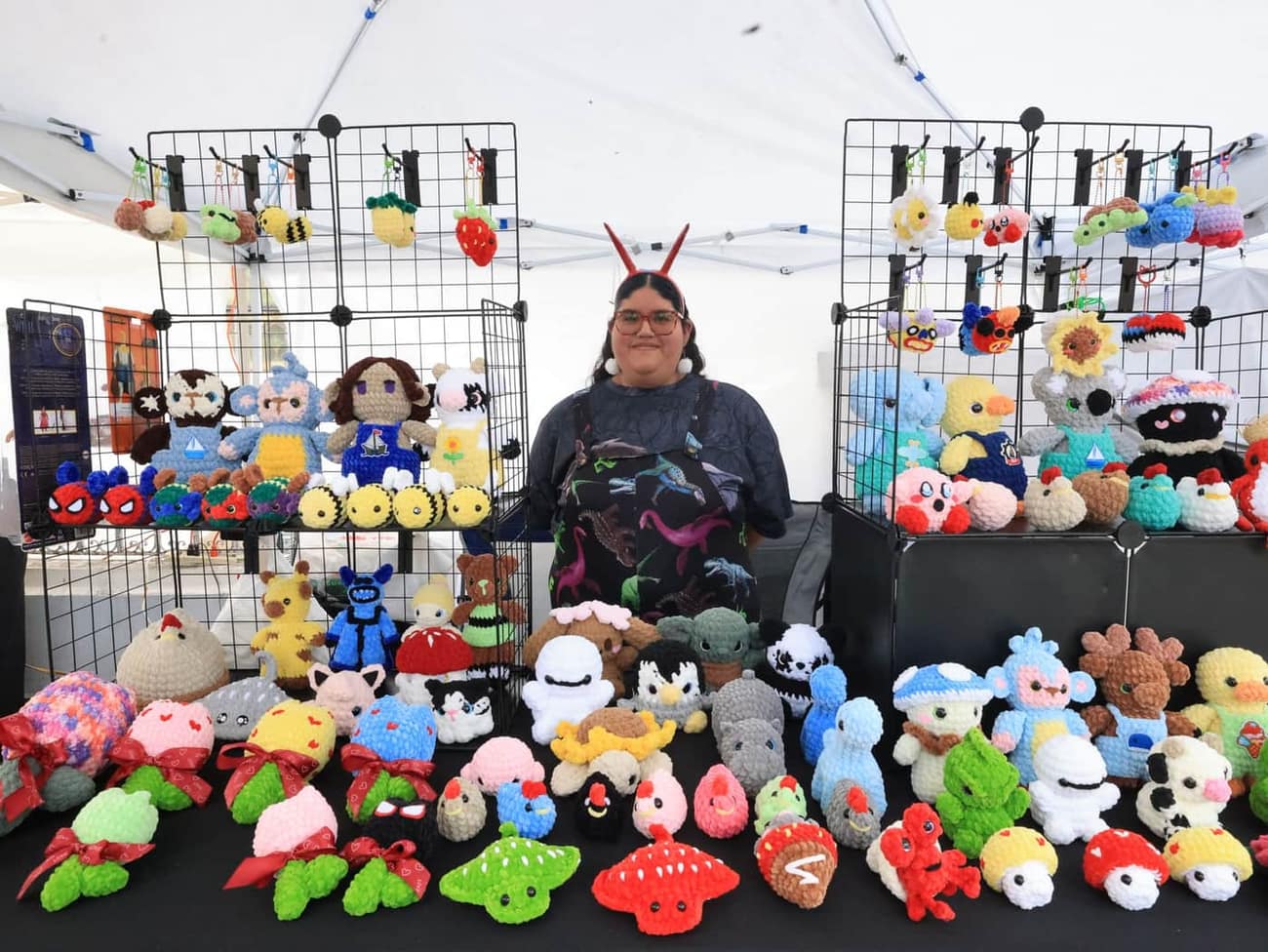
A small range of fast, repeatable items in a consistent palette, made in batches, listed once, with the photography done in one session. Add the occasional high-value commissioned piece at a price agreed in advance, and treat that as the exception rather than the business.
If what you actually want is to keep making sweaters, keep making sweaters - and give them away or wear them. That is a completely reasonable answer, and it is more honest than pricing forty hours at three.
The things that change the arithmetic
- No photo
SENTRO 48-Needle Knitting Machine
48 needles, tube and flat panel modes, row counter. A hat in minutes rather than an evening is the only thing that changes hat economics.
- No photo
Red Heart Super Saver
364yd per 198g skein with no dye lot on the solids. Yardage per skein and repeatability are what matter when you are buying to make, not to enjoy.
- No photo
Clover Pom-Pom Maker Set
Four sizes from 35mm to 85mm, with a measuring scale on the arch. Trims and embellishments are minutes, not hours.
- No photo
Clover Patchwork Scissors
Serrated stainless blades in four sizes. Unglamorous, and you will use them on every single item.
Questions people actually ask
What yarn crafts sell best?
Small, fast, repeatable items - scrunchies, coasters, keyrings, ornaments, pom-pom trims - and machine-assisted production like crank-knitted hats. Anything where the making time is minutes rather than evenings survives the arithmetic; adult garments do not.
Can you make money knitting or crocheting?
From selling finished garments by hand, rarely - the hours involved do not match what buyers will pay. From selling patterns, teaching, fast repeatable small items, or machine-assisted production, yes. Time one complete item end to end and do the arithmetic before committing.
How do I price my handmade crochet items?
Time a complete item including weaving in ends, blocking, photographing and packing, add the yarn and notions, add the per-sale fees and postage, then apply an hourly rate you would accept. If the result is far above what similar items sell for, change the item rather than the rate.
Can I sell items made from someone else's pattern?
It depends on the pattern. Many designers explicitly permit selling finished objects, some restrict it, and some prohibit it. The pattern itself is copyrighted either way - check the specific terms rather than assuming a general rule.
What yarn should I use for items I plan to sell?
High yardage per skein, no dye lot, machine washable, and reliably available over a year. That is close to the opposite of how you would choose yarn for yourself - a cheap workhorse acrylic is usually the correct choice.