The picks
Best Knitting Machines for Beginners
Forty-six needles and a handle. It makes a tube in minutes, and it will never make you a fitted sweater.
By Sawyer V. · Published September 12, 2026
Disclosure: we earn a commission when you buy through the links on this page, at no extra cost to you. It never decides what we recommend or how we rank it - read the full disclosure.
The short answer
Buy a 46 or 48 needle crank machine and expect it to make tubes and flat panels in one fixed gauge, in DK to worsted weight yarn. It will make a hat in about fifteen minutes. It will not shape, it will not purl, and it will not make a fitted garment - those are hand-knitting or a flatbed machine, which is a different and much more expensive category.
| # | Product | Best for | Role | Price |
|---|---|---|---|---|
| 1 | No photoaddi Express Kingsize Knitting Machine46 needles, a mechanical row counter, and screws that actually hold it to the table. | Someone who will use it more than twice | Machine | Check price on Amazon#ad disclosure |
| 2 | No photoSENTRO 48-Needle Knitting Machine48 needles, both modes, a row counter, and a much lower barrier to entry. | Hats, tubes and finding out if you like machine knitting | Machine | Check price on Amazon#ad disclosure |
| 3 | No photoLion Brand Wool-Ease Thick & QuickSuper bulky at the top of the stated range jams the carriage. | Hand knitting, where it is excellent | Yarn | Check price on Amazon#ad disclosure |
| 4 | No photoLion Brand HeartlandSmooth worsted acrylic sits in the middle of every machine's stated range. | Hats and tubes that come off cleanly | Yarn | Check price on Amazon#ad disclosure |
| 5 | No photoClover Chibi Darning Needle Set (Bent Tip)A machine tube comes off live. Something has to close it. | Closing the crown of every machine-knit hat | Tapestry needles | Check price on Amazon#ad disclosure |
addi Express Kingsize Knitting Machine
addi · Best for someone who will use it more than twice
The German-made crank machine, with 46 needles, a mechanical row counter and screw fasteners that actually hold it to the table.
- Needles
- 46
- Yarn
- Recommended yarn thickness 3.5mm to 8mm (DK to super bulky)
- Counter
- Mechanical row counter included
- Mounting
- Four base feet and two screw fasteners for table mounting
- Also included
- Needle holder, take-off needle, five replacement needles, threading tool, two stoppers
Who it suits
Anyone treating a crank machine as a tool rather than a novelty.
Why it is here
46 needles, recommended yarn thickness 3.5mm to 8mm - DK through super bulky - with a mechanical row counter, four base feet and two screw fasteners for table mounting. The mounting is the part people underrate: a machine that slides while you crank drops stitches, and screw fasteners stop that outright.
What you give up
It is the expensive option in a category where the cheap option works. It also shares every structural limit of the format - one tube diameter, no shaping, no purl.
Specifications from Lion Brand - addi Express Kingsize knitting machine. We have not handled this item - see how we pick.
SENTRO 48-Needle Knitting Machine
SENTRO · Best for hats, tubes and finding out if you like machine knitting
A hand-cranked circular knitting machine that makes a tube or a flat panel, in the size most beginner machine projects are written for.
- Needles
- 48; 22, 32 and 40 needle models also made
- Modes
- T-knitting (tube) and P-knitting (plain panel)
- Counter
- Row counter on the upgraded 48-needle version
- Dimensions
- 40.5 x 37.5 x 22cm (15.9 x 14.8 x 8.7in), 4.3lb
- Also included
- Crochet hook, two yarn needles, wire rack, screwdriver, four suction cups and screws
Who it suits
Anyone curious, anyone making hats in quantity, and anyone buying for a teenager.
Why it is here
48 needles, with 22, 32 and 40 needle models also made, switching between T-knitting for a tube and P-knitting for a flat panel. The upgraded 48-needle version carries a row counter. It ships with a crochet hook, two yarn needles, a wire yarn rack, a screwdriver and four suction cups.
What you give up
Suction cups rather than screw fasteners on the base, and they let go on anything but a smooth table. Build quality is the trade being made here, and jams are a normal part of using one.
Specifications from SENTRO knitting machine user manual - model list and modes. We have not handled this item - see how we pick.
Lion Brand Wool-Ease Thick & Quick
Lion Brand · Best for hand knitting, where it is excellent
The super bulky the whole arm-knitting and chunky-blanket category is built on, at a gauge that finishes a throw in a weekend.
- Fiber
- 80% acrylic, 20% wool (fiber ratio varies on some heathered colorways)
- Weight
- 6 Super Bulky
- Skein
- 6oz / 170g, 106yd / 97m
- Gauge
- 9 sts x 12 rows on US 13 (9mm)
- Hook
- M (9mm)
- Care
- Machine wash and dry
Who it suits
Not machine knitters, unless your machine explicitly states it takes category 6.
Why it is here
80% acrylic, 20% wool, category 6 super bulky, 106yd per 170g. Crank machines quote a yarn thickness range that appears to include it.
What you give up
Stated maximums are optimistic. Super bulky at the widest end drags in the needle hooks, and a jam on a crank machine means dropped stitches across the whole round rather than one stitch. Stay a band below whatever the machine claims.
Specifications from Lion Brand product page. We have not handled this item - see how we pick.
Lion Brand Heartland
Lion Brand · Best for hats and tubes that come off cleanly
A soft all-acrylic worsted in a 5oz skein - a lot of yardage per skein, which matters when a blanket needs eight of them.
- Fiber
- 100% acrylic (solids); 94% acrylic, 6% rayon (tweeds)
- Weight
- 4 Medium / worsted
- Skein
- 5oz / 142g, 251yd / 230m (solids)
- Gauge
- 16 sts x 22 rows on US 9 (5.5mm)
- Hook
- J-10 (6mm), 12 sc x 15 rows
- Care
- Machine wash gentle, tumble dry low, no bleach
Who it suits
Anyone whose first three attempts jammed.
Why it is here
100% acrylic in the solids, worsted, 251yd per 142g skein, knitting to 16 sts x 22 rows on US 9. Smooth, evenly plied worsted is what crank machines are built around - it feeds without catching and it does not shed into the mechanism.
What you give up
Worsted on a fixed-gauge machine gives a fairly open fabric, because the needle spacing is not adjustable. Good for hats and cowls, thin for anything meant to be warm on its own.
Specifications from Lion Brand product page. We have not handled this item - see how we pick.
Clover Chibi Darning Needle Set (Bent Tip)
Clover · Best for closing the crown of every machine-knit hat
Three blunt bent-tip tapestry needles in a lidded tube, which is the only reason a tapestry needle is ever findable twice.
- Contents
- Three needles plus a holding tube
- Tip
- Bent, blunt - hooks the yarn without splitting the stitch
- Best with
- DK weight yarns and thinner
- Use
- Weaving in ends, seaming, grafting
Who it suits
Everyone with a crank machine, on every single project.
Why it is here
Three blunt bent-tip darning needles in a holding tube, for DK weight and thinner. The crown of a machine-knit hat is closed by threading the live stitches and drawing them tight - and a bent tip picks up a live stitch without splitting it.
What you give up
DK and thinner only, so a bulky tube needs a jumbo needle. It is a hand-finishing tool on a machine project, which is the point: the machine does not finish anything.
Specifications from Clover Chibi darning needle set (bent tip) - retail specification. We have not handled this item - see how we pick.
What a crank machine is
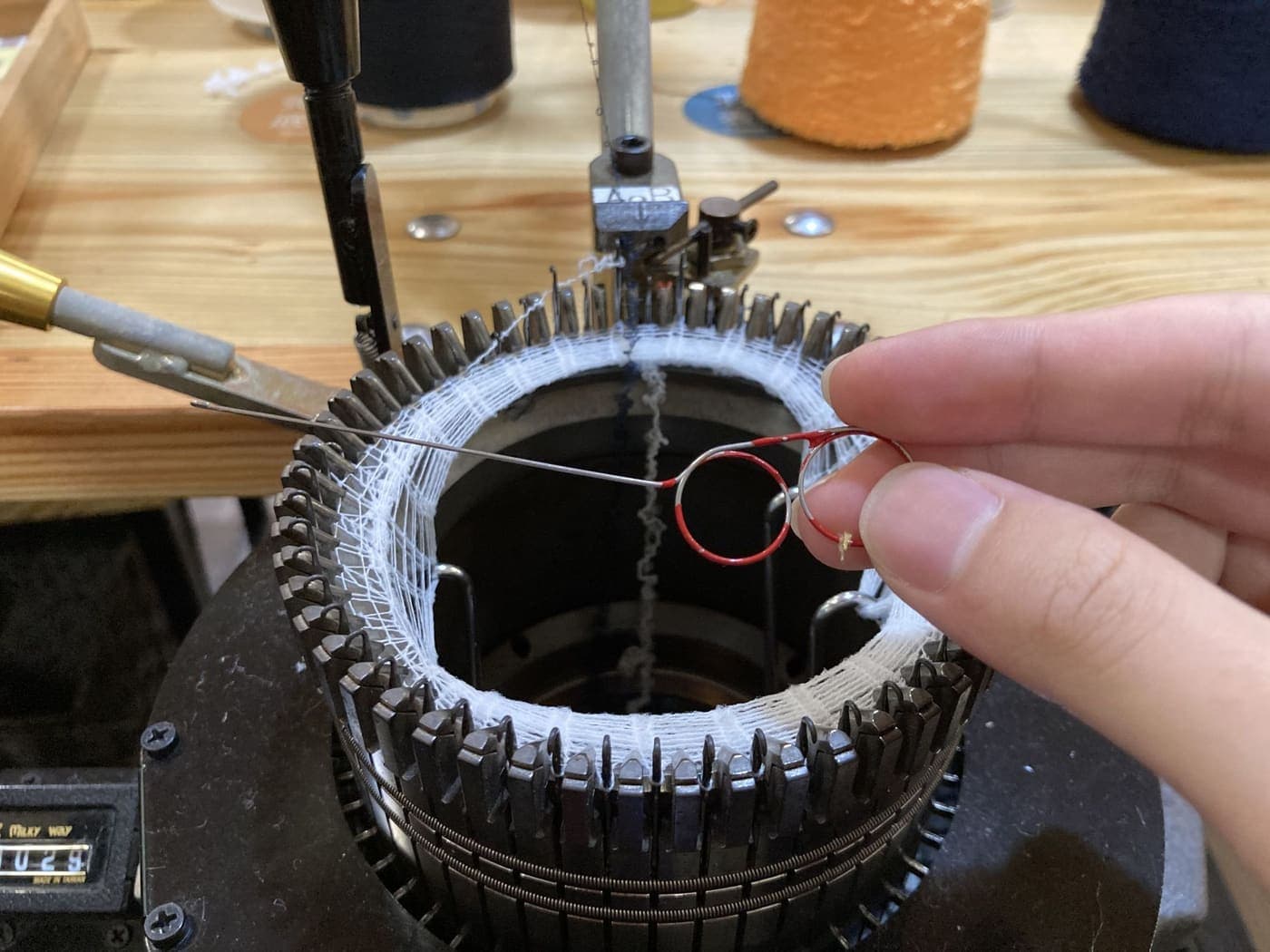
A ring or a row of latch-hook needles in a housing. You thread the yarn, turn a handle, and a cam pushes each needle up and down in turn - the same knit stitch a hand knitter makes, made mechanically, at a few hundred stitches a minute.
This is the cheap, domestic end of machine knitting. The other end is the flatbed machine with a moving carriage and individually selectable needles, which does patterning, shaping and purl. Almost everything sold as a 'beginner knitting machine' is the crank type.
Needle count is the circumference
| Needles | Tube suits | Panel suits |
|---|---|---|
| 22 | Baby hats, cuffs, small toys | Narrow strips |
| 32 | Child hats, mittens, cowls | Scarves |
| 40 | Adult hats, generous cowls | Wide scarves |
| 46-48 | Adult hats, snoods, bag bodies | Blanket strips to seam |
The circumference is not adjustable. A 48-needle machine makes exactly one tube size, and every hat it makes is that size - fitted by how you close the crown and how deep you fold the brim, not by the knitting.
Yarn that works, and yarn that jams
- Smooth worsted acrylic is the sweet spot. It feeds cleanly and does not shed.
- DK works and gives a tighter, better-looking fabric on most machines.
- Wool works if it is smooth and firmly plied; a soft single will fluff into the mechanism.
- Chenille, boucle, eyelash, anything textured jams. The pile catches in the needle hooks.
- Super bulky jams on most machines regardless of what the stated range says.
The general rule is to stay one weight band below whatever the machine claims to accept. Weight bands are on the yarn weight chart.
What it genuinely cannot do
- Purl. Every stitch is a knit stitch. Ribbing has to be hand-finished or faked.
- Shape. No increases, no decreases, no armholes. The tube is the tube.
- Change gauge. The needle spacing is fixed.
- Colorwork. You can change color between rounds. Stranded patterning needs selectable needles, which this format does not have.
- Finish anything. Every project comes off live and has to be closed by hand.
That list is not a criticism - it is the specification. A crank machine is a fast way to produce plain knitted tube, and plain knitted tube is genuinely useful.
What people actually make on them
- Hats, in quantity. The obvious one, and the reason most machines are bought. Charity knitting and craft stalls both run on this.
- Cowls and snoods, closed at both ends or left as a tube.
- Blanket strips, knitted flat and seamed - see how to seam knitting and crochet.
- I-cord and bag handles, on the smallest machines.
- Toy bodies and limbs, stuffed tubes closed at both ends.
If you are making to sell, this is the machine that makes the arithmetic work - yarn crafts to sell covers what that actually looks like.
Jams, and why they happen
- Tension too loose. The yarn needs to be under steady tension coming in; the wire rack that ships with most machines exists for this.
- Yarn too thick. The most common cause. Drop a weight band.
- Machine moving. Suction cups let go. Screw fasteners do not.
- Cranking too fast. A dropped stitch at speed becomes a whole dropped round.
- A stitch not seated. Check the first round by hand before you build up speed.
Machine, loom, or needles?
| Crank machine | Knitting loom | Needles | |
|---|---|---|---|
| Speed for one hat | About 15 minutes | An evening | Several evenings |
| Gauge control | None | None | Full |
| Shaping | No | Limited | Full |
| Cost | Highest | Low | Lowest |
| Portable | No | Barely | Yes |
| Best for | Quantity | Learning, hands | Everything else |
A loom does most of what a crank machine does, more slowly and far more cheaply - see best knitting looms. Buy the machine when the quantity justifies it, not before.
What we would buy
- If you will use it: the 46-needle machine that screws to the table.
- To try it: a 48-needle crank machine.
- Yarn that feeds: smooth worsted acrylic.
- To close the crown: bent-tip darning needles.
- Not in the machine: super bulky.
Questions people actually ask
Are knitting machines worth it for beginners?
If you want quantity - hats for a stall, charity knitting, toy tubes - yes. A crank machine makes a hat in about fifteen minutes. If you want one good garment, no: it cannot shape, cannot purl and cannot change gauge.
What yarn works in a circular knitting machine?
Smooth, evenly plied worsted or DK, in acrylic or a firm wool. Textured yarns - chenille, boucle, eyelash - jam in the needle hooks, and super bulky jams on most machines whatever the stated range says. Stay a band below the claimed maximum.
How many needles do I need on a knitting machine?
46 or 48 for adult hats and cowls, 40 for a snugger adult hat, 32 for children, 22 for babies and cuffs. The circumference is fixed by the needle count and cannot be adjusted.
Can a knitting machine make a sweater?
Not a fitted one. A crank machine makes tubes and flat panels in one gauge with no shaping, so a sweater would have to be assembled from rectangles. Shaped garments need a flatbed machine with selectable needles, or hand knitting.
Why does my knitting machine keep dropping stitches?
Usually yarn that is too thick, tension that is too loose coming in, or the machine sliding on the table. Crank slowly until the first few rounds are seated, use the yarn guide rack, and mount the machine with screws rather than suction cups if you can.