Reference
Crochet Thread Sizes Explained
Two numbering systems, both running backwards, neither standardized across brands. Here is what each number means.
By Sawyer V. · Published September 12, 2026
Disclosure: we earn a commission when you buy through the links on this page, at no extra cost to you. It never decides what we recommend or how we rank it - read the full disclosure.
The short answer
Crochet thread sizes run backwards: the higher the number, the finer the thread. Size 3 is the thickest in common use and size 30 is much finer. Size 10 is the default - if a pattern just says 'crochet thread', it almost certainly means size 10. Steel hook numbers also run backwards, and unlike thread sizes they are not consistent between brands.
The numbering, and why it is backwards
Thread numbering descends from cotton count, an old textile system where the number describes how many lengths of a given weight you get from the fiber. More lengths per unit weight means a finer thread - so a larger number means a thinner thread.
You do not need the history to use it. You need one rule: higher number, finer thread. The manufacturer of the most widely sold range states it plainly of its own size 3 line, describing it as thicker than, and working up faster than, its smaller-numbered threads.
The sizes in common production
| Size | Line | Stated use |
|---|---|---|
| 3 | Fashion Crochet Thread | Lustrous, drapes well; shawls and accessories. Thicker and faster than smaller sizes |
| 10 | Classic 10 | Traditional thread crochet - tablecloths and doilies |
| 10 | Metallic Crochet Thread | Same size, metallic finish |
| 20 | Fine Crochet Thread | Finer work |
| 30 | Extra Fine Crochet Thread | Finest in the range |
Sizes 40, 50, 80 and above exist in specialist tatting and bobbin lace threads. They are not what a crochet pattern means, and they are not generally stocked alongside yarn.
Where thread sits against yarn
Crochet thread is not a separate universe from yarn - it is the bottom of the same scale. The Craft Yarn Council's category 0 covers both lace weight yarn and 10-count thread.
| Category | Includes | Crochet hook | Crochet gauge / 4in |
|---|---|---|---|
| 0 Lace | Lace yarn, 10-count thread | Steel 6, 7, 8 (1.6-1.4mm) or regular B-1 (2.25mm) | 32-42 double crochet |
That is one row, for one thread size. The standard does not define rows for sizes 3, 20 or 30 - which is exactly why patterns in those sizes name a specific hook rather than a category. The full weight table is on the yarn weight chart.
Steel hooks, and the brand problem
Steel hooks are numbered on their own scale, which also runs backwards - a steel 14 is finer than a steel 0. That much is consistent.
What is not consistent is what those numbers mean in millimeters. Two ranges we list both make a hook called No. 10, and they are not the same tool.
| Brand | Range | Their No. 10 |
|---|---|---|
| Susan Bates Steelite | Six hooks: 0 (2.55mm), 1 (2.35mm), 7 (1.5mm), 8 (1.4mm), 9 (1.25mm), 10 (1.15mm) | 1.15mm |
| Clover Amour Steel | Sub-2mm range, for crochet thread rather than yarn | 0.75mm |
A 0.4mm difference sounds small and is not - it is more than a third of the smaller hook's diameter. Always work from the millimeter size, never from the steel hook number. This is the single most useful thing on this page, and hook size chart covers the regular-hook scale alongside it.
Which thread size for which project
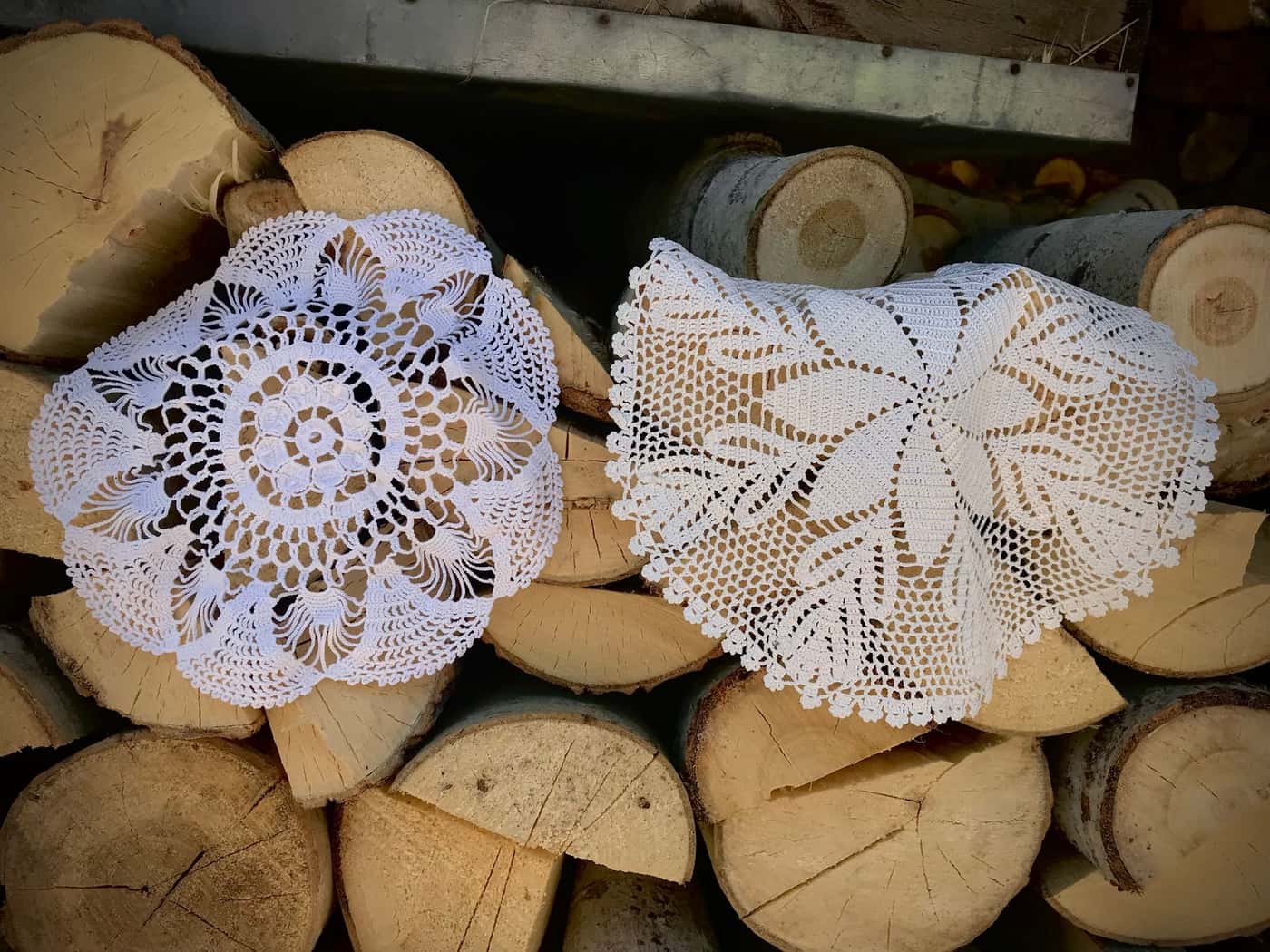
- Doilies, coasters and traditional lace: size 10. Almost every vintage pattern in circulation assumes it.
- Tablecloths and bedspreads: size 10 for a normal lifetime, size 20 or 30 if you want the fineness and have the patience.
- Shawls and wearables: size 3, which drapes and works up faster.
- Amigurumi in miniature: size 10, worked tightly.
- Jewelry, snowflakes, edgings: size 20 or finer, where the stiffness after starching matters more than the speed.
- Your first thread project: size 3. Everything is the same, at a scale you can see.
Gauge in thread
- Swatch, as with yarn. Thread gauge varies at least as much between crocheters as yarn gauge does.
- Measure over more stitches. At 32 to 42 double crochet per 4in, a one-stitch error over four inches is a much larger proportional error than in worsted.
- Expect to go down a hook size from whatever the pattern says if your tension is loose - thread shows loose tension far more visibly than yarn does.
- Block before measuring. Thread lace opens up dramatically when blocked, and an unblocked swatch is not the fabric.
Knitting gauge and swatching covers the method; it applies unchanged to crochet, only the stitch names differ.
Mercerization
Almost all crochet thread is mercerized cotton. Mercerization treats the cotton under tension in a caustic solution, which makes the fiber smoother, stronger and more lustrous, and helps it take dye.
For thread crochet that matters three ways: the sheen is a large part of why a doily looks the way it does, the added strength survives being worked at very tight tension, and the smooth surface means the hook does not fuzz the thread as it works. Cotton yarn pros and cons has the fiber side.
Buying by yardage
Thread is sold in balls whose yardage varies by color within the same product - one common size 10 line gives 400 yards in white, ecru and natural, 350 in solid colors and 300 in shaded colors.
That is a 25 percent swing across one product, so a pattern quoting 'two balls' is quoting two balls of one particular color family. Convert to yardage before you buy, as you would for any yarn - how much yarn do I need has the arithmetic, and the same area method works for a doily.
The thread and the hooks that go with it
- No photo
Aunt Lydia's Classic Crochet Thread Size 10
Size 10, 100% mercerized cotton, 3-ply. Yardage varies by color: white, ecru and natural 400yd; solids 350yd; shaded colors 300yd.
- No photo
Clover Amour Steel Crochet Hook Set
Steel hooks in the sub-2mm range with the elastomer grip - and note their No. 10 is 0.75mm.
- No photo
Susan Bates Steelite Steel Crochet Hook Set
Six nickel-plated steel hooks: 0 (2.55mm), 1 (2.35mm), 7 (1.5mm), 8 (1.4mm), 9 (1.25mm), 10 (1.15mm). Their No. 10 is not Clover's No. 10.
- No photo
Susan Bates Knit-Chek Needle Gauge
Measures US 0 / B-1 to P-16 (2.0mm to 11.5mm) - the tool for identifying an unmarked hook, though the finest steel sizes fall below its range.
Questions people actually ask
What do crochet thread size numbers mean?
They describe fineness, and they run backwards - the higher the number, the thinner the thread. Size 3 is the thickest in common use, size 10 is the standard, and sizes 20 and 30 are progressively finer.
What size crochet thread do most patterns use?
Size 10. If a pattern simply says 'crochet thread' with no number, it almost certainly means size 10 - it is the traditional size for doilies, tablecloths and edgings.
Is size 3 crochet thread thicker than size 10?
Yes. The manufacturer of the most widely sold range describes its size 3 line as thicker than, and working up faster than, its smaller-numbered threads. Size 3 is the usual choice for shawls and accessories.
What hook do I use with size 10 crochet thread?
The Craft Yarn Council puts 10-count thread in category 0 with a steel 6, 7 or 8 - 1.6mm to 1.4mm - or a regular B-1 at 2.25mm, at a gauge of 32 to 42 double crochet over 4in. Work from the millimeter size rather than the steel hook number.
Are steel crochet hook numbers the same across brands?
No, and this catches people out. Two ranges we list both make a hook called No. 10: one is 1.15mm and the other is 0.75mm. Always buy and work from the millimeter size.
What is mercerized cotton thread?
Cotton treated under tension in a caustic solution, which makes it smoother, stronger and more lustrous and helps it take dye. Nearly all crochet thread is mercerized - the sheen is a large part of why a finished doily looks the way it does.
Sources
- Yarnspirations - Aunt Lydia's Classic Crochet Thread Size 10
- Yarnspirations - Aunt Lydia's crochet thread range, by size
- Clover USA - Amour Steel Crochet Hooks specification
- WEBS - Susan Bates Steelite crochet hook set
- Susan Bates Knit-Chek 14099 - retail specification
- Craft Yarn Council - Standard Yarn Weight System